
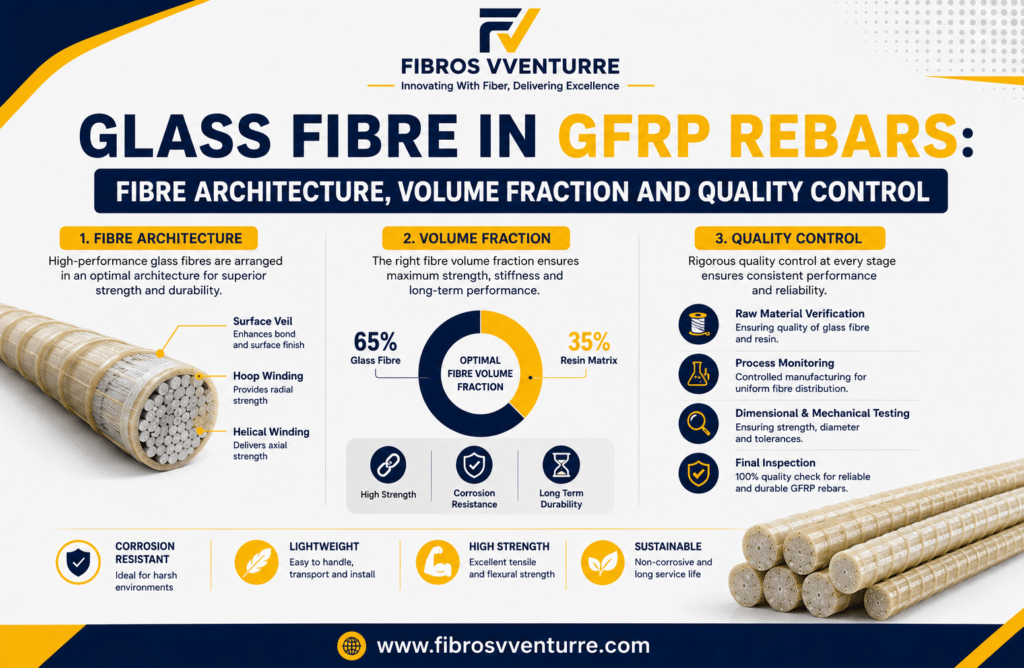
Glass fibre is the primary load-carrying reinforcement in GFRP rebar. Understanding how the fibres are arranged, how much fibre is present, how they interact with the polymer matrix and how their quality is controlled is therefore essential for engineers, consultants, contractors and procurement teams.
GFRP rebars are composite reinforcement products consisting of continuous glass fibres embedded within a polymer matrix. Unlike conventional steel reinforcement, their structural behaviour cannot be evaluated simply by treating them as a steel bar of the same diameter. The fibre architecture, resin system, surface profile, manufacturing quality and certified material properties all contribute to the performance of the finished reinforcement.
For Indian infrastructure, this subject is becoming increasingly important because BIS has published IS 18256:2023 for solid round GFRP bars and IS 18255:2023 for FRP bar test methods. IRC:137-2022 also provides guidance for GFRP bars in applicable road projects.
The key engineering question is therefore not simply “How much glass fibre is in the bar?” but rather:
Does the complete fibre–resin–surface–manufacturing system provide the required structural, durability and serviceability performance for the intended application?
1. Why Glass Fibre Architecture Matters
The continuous glass fibres provide most of the tensile reinforcement within a GFRP bar. Their orientation is particularly important.
For a conventional straight GFRP rebar, the principal fibres are generally aligned predominantly along the longitudinal direction because the bar is primarily required to carry tensile forces along its length.
This makes fibre architecture an important manufacturing parameter.
Engineers should understand:
- Fibre type and quality
- Fibre orientation
- Continuity of fibres
- Fibre distribution
- Fibre impregnation
- Fibre volume fraction
- Resin quality
- Surface treatment
- Manufacturing consistency
A product specification should identify the exact product and its certified properties rather than relying on a generic statement about glass-fibre content. The source material specifically recommends identifying the product, diameter range, resin family, surface configuration, test basis and applicable reduction factors so that the design remains traceable through procurement.
2. Fibre Volume Fraction: Why It Is Important
Fibre volume fraction refers to the proportion of the composite volume occupied by reinforcing fibres.
In general composite engineering, the fibre and resin perform different functions. The fibres provide the principal reinforcement, while the polymer matrix binds the fibres together, transfers stresses between them and protects the fibre architecture.
However, higher fibre content does not automatically mean a better GFRP rebar.
A technically suitable product requires a balanced composite system. Excessive or insufficient resin, poor impregnation, voids, uneven fibre distribution or inconsistent curing can affect the quality of the finished bar.
Therefore, procurement should focus on verified finished-product performance, supported by appropriate testing and manufacturing quality control, rather than purchasing solely on a claimed percentage of glass fibre.
This distinction is especially important when comparing different manufacturers. Two products may both be described as “GFRP rebars” while having different fibre architectures, surface systems, resin systems and certified design properties.
3. Fibre–Resin Interaction
The glass fibres cannot be considered independently from the polymer matrix.
The resin surrounds and binds the fibres to create the composite reinforcement. The final performance depends on the interaction between these materials and the quality of the manufacturing process.
Durability is consequently influenced by several interconnected factors, including glass quality, resin quality, manufacturing quality, surface treatment, sustained stress, temperature and chemical environment.
This is why the term “non-corrosive” should not be treated as a complete durability specification.
GFRP avoids the electrochemical rusting mechanism associated with carbon-steel reinforcement, but composite durability remains an engineering consideration. Exposure conditions must be evaluated against the qualified performance of the specific product.
For aggressive environments, engineers should therefore examine the manufacturer’s technical documentation, applicable test reports and project-specific requirements before approval.
4. Fibre Orientation and Structural Behaviour
GFRP reinforcement generally has high tensile capacity but a lower elastic modulus than steel and essentially linear-elastic behaviour until rupture.
This creates an important difference in structural design.
With steel, yielding is a familiar part of reinforced-concrete design. GFRP does not behave in the same way. Consequently, strength alone is not enough to establish suitability.
The source material highlights the importance of:
- Deflection
- Crack width
- Reinforcement ratio
- Bar spacing
- Bond
- Development length
- Lap splices
- Bent reinforcement
- Transverse reinforcement detailing
These checks must be carried out using the governing GFRP design methodology and certified properties of the selected product.
For this reason, a GFRP rebar should not normally be substituted for a steel bar on a simple one-for-one basis.
5. Surface Profile and Bond
The glass fibres carry tensile forces, but the reinforcement must also transfer those forces effectively to surrounding concrete.
This makes the bar surface profile extremely important.
GFRP products may use different surface systems, including sand-coated surfaces, ribs, wraps or combinations of these features. These systems influence interaction between the bar and concrete.
Development length, lap splices and anchorage should therefore be designed using the approved product and applicable design methodology.
A procurement team should not assume that two products with the same nominal diameter and tensile-strength claim will have identical bond performance.
The source specifically states that surface configuration participates in bond and force transfer and that different profiles should not be considered interchangeable without appropriate qualification evidence.
6. Manufacturing Quality Control
High-quality glass fibre alone cannot guarantee a high-quality GFRP rebar.
Manufacturing quality must ensure consistency from raw material through finished product.
A robust quality-control system should address:
- Incoming raw-material verification
- Fibre identification and handling
- Resin-system control
- Fibre impregnation
- Composite formation
- Surface formation
- Curing/process control
- Dimensional inspection
- Product identification
- Finished-product testing
- Batch traceability
The project should be able to connect supplied reinforcement to its production batch and corresponding test documentation.
The source recommends an inspection and test plan that connects procurement requirements with receiving inspection, certificates, laboratory testing and installation hold points. Traceability should allow installed reinforcement to be linked to a production batch or delivery lot.
7. What Should a GFRP Test Certificate Contain?
A technically useful test certificate should provide more than a single tensile-strength number.
At minimum, documentation should clearly identify:
- Product
- Bar diameter
- Batch or traceability reference
- Test standard/method
- Laboratory
- Relevant measured properties
- Test date
Additional requirements may be imposed by the project specification.
This documentation is particularly important for government and major infrastructure projects because design, procurement, quality assurance and site teams must be able to establish exactly what material has been supplied.
8. Indian Standards and Approval
For Indian projects, IS 18256:2023 addresses solid round GFRP bars for concrete reinforcement, while IS 18255:2023 addresses test methods for FRP bars. For road projects, IRC:137-2022 provides relevant guidance within its applicable scope.
However, the existence of a standard does not mean that every GFRP product is automatically approved for every project.
The final design and material approval remain subject to:
- Governing project specifications
- Engineer of Record
- Client/authority requirements
- Certified product properties
- Applicable standards
- Testing requirements
- Approved drawings
- Construction procedures
A professional technical submittal should therefore include manufacturer information, product data, relevant certification, independent test reports, design properties, drawings, bar schedules, method statements and inspection plans.
9. Construction Considerations
GFRP is lightweight, which can make handling easier, but lightweight reinforcement also requires appropriate cage restraint during concrete placement.
Site teams should control:
- Storage
- Bundle identification
- Bar marks
- Cutting
- Tying
- Supports
- Cover
- Laps
- Cage stability
- Pre-pour inspection
The construction procedure should be specifically developed for GFRP rather than copied directly from conventional steel practice.
Bent GFRP shapes should normally be manufactured under ccontrolled factory conditions. Unapproved field bending or reshaping should not be permitted simply because it is common practice with steel.
10. Common Procurement Mistakes
One of the biggest mistakes is comparing GFRP rebar purely on price per kilogram.
Because GFRP and steel have different densities and structural properties, a kilogram-to-kilogram comparison can be misleading.
Procurement should instead compare:
Design requirement → certified properties → required quantity → bar geometry → installation → testing → lifecycle performance
Other common mistakes include:
- Using generic tensile-strength values
- Mixing data from different manufacturers
- Ignoring surface profile
- Failing to verify traceability
- Ordering bent bars without approved drawings
- Treating GFRP exactly like steel
- Assuming non-corrosive means resistant to every environment
- Ignoring serviceability
- Allowing uncontrolled field modifications
The source specifically recommends comparing total installed and lifecycle value rather than relying only on rate per kilogram.
11. Lifecycle Value of Glass Fibre Reinforcement
The commercial value of GFRP should be evaluated over the expected service life of the structure.
The analysis may include:
- Initial reinforcement
- Fabrication
- Transportation
- Installation
- Testing
- Maintenance
- Inspection
- Access
- Repair
- Traffic or production disruption
- Replacement
The justification for GFRP is therefore strongest where reinforcement corrosion represents a significant lifecycle risk.
However, cost savings should never be presented as universal. A credible lifecycle analysis should clearly identify quantities, assumptions, study period and cost basis.
Conclusion
Glass fibre in GFRP rebars is not simply a raw material—it is the principal reinforcing architecture around which the entire composite system is engineered.
Fibre orientation, fibre volume fraction, resin interaction, surface profile, manufacturing quality and traceability all contribute to the performance of the finished GFRP reinforcement.
For engineers, the most important lesson is that a high glass-fibre percentage or a high tensile-strength number alone does not establish product quality. The complete system must satisfy structural, serviceability, bond, durability, constructability and quality requirements.
For procurement teams, the correct approach is to specify the exact product, diameter, shape, surface system, certified properties, testing requirements and traceability requirements.
For contractors, GFRP requires a dedicated installation procedure, particularly for storage, cage restraint, cutting, tying, bends and pre-pour inspection.
For owners and authorities, the strongest evaluation is an evidence-based comparison of structural performance, durability, lifecycle requirements and project-specific risks.
Ultimately, the successful adoption of GFRP reinforcement depends on connecting material science → controlled manufacturing → verified testing → structural design → procurement → construction → as-built documentation.
That complete engineering chain is what transforms glass fibre from a raw reinforcing material into a reliable GFRP reinforcement solution for modern infrastructure
Fibros Vventurre is a trusted manufacturer and supplier of GFRP Rebars in India. We provide high-quality GFRP Rebar Bars and Factory-Bent GFRP Rebars for construction and infrastructure projects.
Looking for the right GFRP Rebar for your project? Our team can help you with sizes, specifications, designs, and applications.
Contact Fibros Vventurre today to find the right GFRP solution for your project and build strong, durable, and long-lasting structures.