Water infrastructure is expected to remain in service for decades while continuously exposed to moisture, chemicals and aggressive environmental conditions. Unlike residential or commercial buildings, structures such as water tanks, sewage treatment plants, drainage channels and wastewater facilities operate in environments where durability is often the most important design requirement.
For many years, conventional steel reinforcement has been used in these structures. While steel provides excellent structural performance, it is susceptible to corrosion when chlorides, moisture or aggressive chemicals penetrate the concrete. Corrosion of reinforcement can lead to cracking, spalling, leakage and costly repairs that may interrupt essential public services.
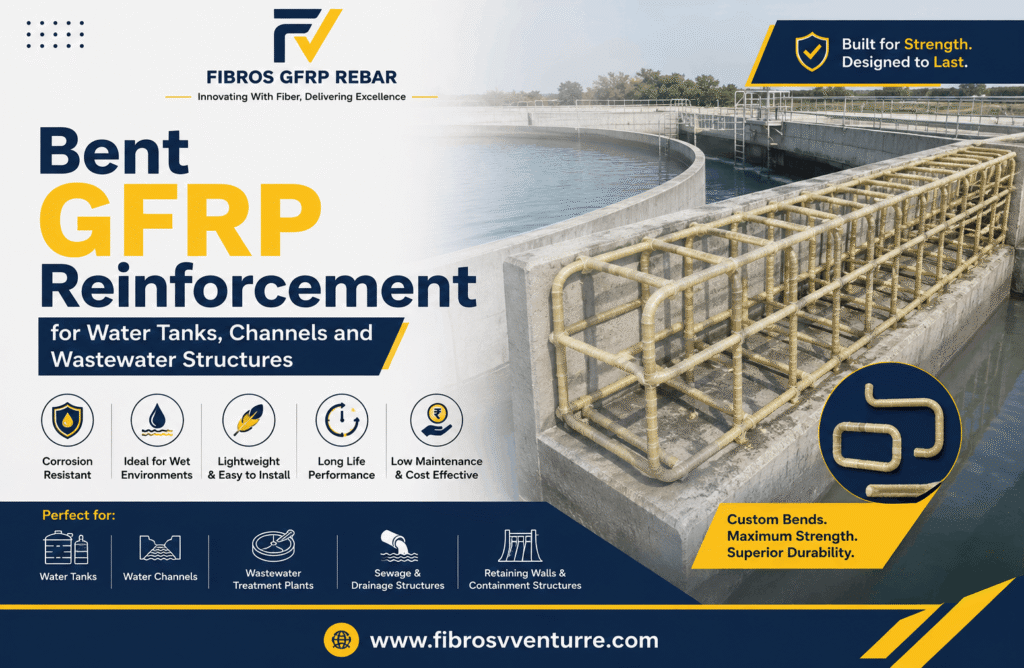
To address these challenges, engineers are increasingly considering Glass Fiber Reinforced Polymer (GFRP) rebars, particularly factory-manufactured bent GFRP bars, for selected water infrastructure applications. These prefabricated L-bars, U-bars, stirrups and custom shapes simplify installation while offering the corrosion resistance associated with nonmetallic reinforcement.
Why Water Infrastructure Requires Special Reinforcement
Concrete used in water-retaining and wastewater structures is constantly exposed to conditions that can shorten the service life of conventional reinforcement.
Typical exposure conditions include:
- Permanent moisture
- Wet–dry cycles
- Chlorides in groundwater
- Sulphates in soil
- Wastewater chemicals
- Cleaning chemicals
- Industrial effluents
- Biological activity
- Abrasion from flowing water
Although high-quality concrete helps protect embedded reinforcement, aggressive exposure over many years can still affect durability if design, detailing and construction quality are not properly managed.
Because water infrastructure is expensive to repair and often difficult to shut down, owners increasingly focus on long-term durability rather than only the initial construction cost.
What Are Bent GFRP Rebars?
Bent GFRP rebars are reinforcement bars manufactured into specific shapes before delivery to site.
Unlike steel reinforcement, sharp bends should not normally be created in straight GFRP bars at the construction site. Instead, the required geometry is produced under controlled factory conditions according to approved drawings or a Bar Bending Schedule (BBS).
Common factory-produced shapes include:
- L-bars
- U-bars
- Open stirrups
- Closed stirrups
- Corner bars
- Circular rings
- Spirals
- Hairpin bars
- Custom project-specific reinforcement
Factory manufacturing improves dimensional consistency and reduces site fabrication work.
Where Bent GFRP Rebars Are Used
Bent GFRP reinforcement may be considered, subject to engineering approval, in:
Water Tanks
Typical locations include:
- Base slab corners
- Wall-to-slab junctions
- Wall intersections
- Roof slabs
- Openings
- Pipe penetrations
L-bars and U-bars help maintain reinforcement continuity in these critical areas.
Wastewater Treatment Plants
Treatment facilities include structures such as:
- Aeration tanks
- Clarifiers
- Equalisation tanks
- Digesters
- Sludge tanks
- Chemical dosing areas
These structures may be exposed to aggressive environments that make durability a key design consideration.
Drainage Channels
Open and covered channels often require reinforcement around:
- Corners
- Expansion joints
- Culvert transitions
- Wing walls
- End walls
Factory-manufactured bent bars simplify installation in these repetitive details.
Irrigation and Water Conveyance
Projects may include:
- Irrigation canals
- Pump houses
- Reservoirs
- Intake structures
- Outlet structures
- Check dams
Bent reinforcement helps accommodate changes in geometry while reducing site fabrication.
Advantages of Factory-Bent GFRP Rebars
Improved Durability
Because GFRP is nonmetallic, it does not rust through the same electrochemical mechanism as carbon steel. This characteristic can be beneficial where corrosion of conventional reinforcement is a major durability concern.
Faster Installation
Receiving reinforcement in ready-to-install shapes reduces:
- Measuring
- Site fabrication
- Cutting
- Bending operations
- Installation time
This can improve productivity on projects with repetitive reinforcement layouts.
Better Dimensional Accuracy
Factory-controlled manufacturing helps produce consistent:
- Bend angles
- Leg lengths
- Inside radii
- Overall dimensions
Accurate reinforcement improves constructability and reduces the likelihood of site adjustments.
Reduced Material Waste
Site fabrication often creates offcuts and damaged bars. Ordering the required shapes directly from the manufacturer can reduce unnecessary waste.
Lower Maintenance Potential
Where reinforcement corrosion would otherwise be a significant maintenance issue, corrosion-resistant reinforcement may contribute to longer service intervals. The actual outcome depends on the complete structural design, concrete quality and environmental exposure.
Design Considerations
Selecting bent GFRP reinforcement requires more than choosing a shape.
The engineer should consider:
- Structural loading
- Concrete strength
- Crack-width requirements
- Development length
- Anchorage
- Bar spacing
- Concrete cover
- Serviceability
- Exposure classification
- Fire requirements
Bent GFRP reinforcement should be detailed using provisions applicable to GFRP-reinforced concrete rather than conventional steel detailing.
Information Manufacturers Need
To produce accurate bent reinforcement, suppliers generally require:
- Approved structural drawings
- Bar Bending Schedule (BBS)
- Bar diameter
- Bend angle
- Leg lengths
- Shape code
- Quantity
- Delivery sequence
Providing complete information before production reduces manufacturing errors and helps maintain the project schedule.
Common Mistakes to Avoid
Avoid these common errors:
- Ordering without an approved BBS
- Assuming steel detailing can be copied directly
- Attempting sharp field bending
- Ignoring handling instructions
- Purchasing only on price without reviewing technical documentation
- Accepting products without verifying test reports and traceability
Frequently Asked Questions
Can bent GFRP rebars be used in drinking-water tanks?
They may be considered where the project design, applicable regulations and material approvals permit their use. Any additional potable-water requirements should be verified for the specific project.
Why use factory-bent bars instead of bending on site?
Factory production provides controlled geometry, consistent quality and reduces the risk of damaging the composite material.
Are bent GFRP bars available in custom shapes?
Yes. Many manufacturers can produce custom reinforcement based on approved drawings or a Bar Bending Schedule, subject to manufacturing capabilities.
Can GFRP reinforcement eliminate all maintenance?
No. While GFRP can reduce concerns related to reinforcement corrosion, the overall durability of a structure still depends on concrete quality, design, workmanship, environmental exposure and maintenance.
Conclusion
Water-retaining and wastewater structures demand reinforcement systems that can perform reliably for decades in challenging environments. Factory-bent GFRP rebars provide an option for projects where corrosion resistance, dimensional accuracy and efficient installation are important considerations.
Whether used in water tanks, treatment plants, drainage channels or irrigation infrastructure, their successful application depends on appropriate engineering design, verified product quality and proper installation practices.
About FIBROS VENTURE
FIBROS VENTURE manufactures and supplies straight and factory-bent GFRP rebars for infrastructure, industrial and water-related construction projects across India.
Our product range includes:
- Straight GFRP Rebars
- L-Bars
- U-Bars
- GFRP Stirrups
- Circular Rings
- Custom Bent GFRP Shapes