As Glass Fibre Reinforced Polymer (GFRP) rebar becomes increasingly important in corrosion-sensitive and specialised concrete structures, engineers need design provisions that recognise how GFRP behaves differently from conventional reinforcing steel.
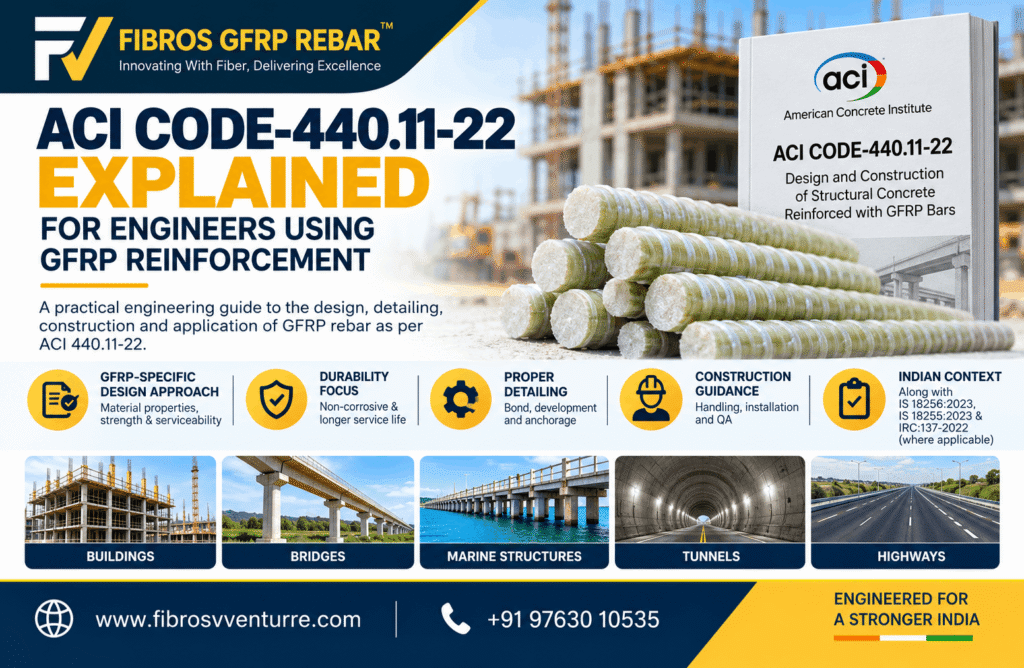
One of the key international references is ACI CODE-440.11-22, published by the American Concrete Institute for structural concrete reinforced with GFRP bars. For Indian engineers, the code is particularly useful as an international engineering reference, but it must be considered alongside applicable Indian standards and project requirements. The source article identifies IS 18256:2023, IS 18255:2023 and IRC:137-2022 where applicable as important Indian references. Pasted text
The fundamental message is simple: GFRP must be designed as GFRP—not treated as a direct substitute for steel.
What Is ACI CODE-440.11-22?
ACI CODE-440.11-22 provides a structural design framework for concrete reinforced with GFRP bars. It helps engineers address the characteristics that distinguish GFRP reinforcement from conventional steel.
GFRP consists of continuous glass fibres embedded in a polymer matrix. Its material behaviour differs significantly from steel in areas such as elastic stiffness, tensile response, bond, development, durability and fabrication.
Therefore, the engineering question should not simply be:
“Is GFRP stronger than steel?”
A more appropriate question is:
“Can the selected GFRP reinforcement system satisfy the strength, serviceability, durability, bond and detailing requirements of this particular structural element?”
The source specifically stresses that GFRP has high tensile capacity but generally lower elastic modulus than steel and essentially linear-elastic behaviour to rupture. Pasted text
Why GFRP Requires a Different Design Philosophy
Conventional reinforced-concrete design has developed around the mechanical characteristics of reinforcing steel, including its stiffness and yielding behaviour.
GFRP behaves differently.
It does not exhibit the conventional yielding plateau associated with reinforcing steel. Instead, its tensile behaviour is essentially linear-elastic until rupture.
This difference affects how engineers approach:
- strength;
- deflection;
- cracking;
- reinforcement ratio;
- bar spacing;
- bond;
- development and lap lengths; and
- structural failure hierarchy.
As a result, simply replacing a 12 mm steel bar with a 12 mm GFRP bar, for example, is not an acceptable universal design method.
The complete member must be evaluated using an appropriate GFRP design framework and the certified properties of the actual selected reinforcement. Pasted text
Serviceability Can Be Critical
One of the most important considerations when designing GFRP-reinforced concrete is serviceability.
GFRP generally has a lower elastic modulus than conventional reinforcing steel. Consequently, member stiffness, curvature, crack widths and deflections can become particularly important.
Engineers should therefore consider serviceability early in the design rather than treating it as a final verification after reinforcement has already been selected.
An efficient GFRP design may require coordination of:
Member Depth + Reinforcement Ratio + Bar Spacing + Concrete Properties + Support Conditions
The objective is not to force GFRP into an existing steel reinforcement schedule. The objective is to design the concrete-GFRP structural system to satisfy its required performance. Pasted text
Design Properties Must Be Product-Specific
Another important principle is the use of traceable material properties.
Engineers should distinguish between tested, declared, guaranteed and design properties rather than selecting one generic tensile-strength number from a brochure.
A proper calculation package should identify relevant information such as:
Product → Diameter → Resin System → Surface Configuration → Test Basis → Applicable Design/Reduction Factors
Properties from different manufacturers, diameters or test methods should not be mixed without an appropriate engineering basis.
This requirement also has procurement implications. If the structural design was completed using the certified properties of a particular qualified product, procurement should not substitute another product solely because it has the same nominal diameter or a lower price. Pasted text
Durability and Corrosion Resistance
GFRP’s resistance to conventional reinforcement corrosion is one of the major reasons for considering it in aggressive environments.
Unlike carbon steel, GFRP does not undergo the same electrochemical rusting mechanism. This can make it particularly relevant for structures exposed to moisture, chlorides and other environments where reinforcement corrosion represents a significant lifecycle risk.
However, “non-corrosive” does not mean unaffected by every environment.
Composite durability still depends on factors including:
Resin Quality | Fibre Protection | Alkaline Exposure | Moisture | Chemicals | Temperature | Sustained Stress | Manufacturing Quality
Therefore, durability claims should be supported by appropriate qualification testing, manufacturing controls and relevant field evidence. Pasted text
Bond, Development and Anchorage
Reinforcement cannot perform effectively unless forces can be transferred between the bar and surrounding concrete.
GFRP products may use different surface configurations, including sand-coated, ribbed, helically wrapped or combined surface systems.
These surface characteristics affect bond performance.
Consequently, development lengths, lap splices and anchorage details should follow the approved design method and qualified GFRP system.
Site teams should not reduce lap lengths, relocate reinforcement or modify anchorage simply because GFRP bars are lightweight.
Any field change affecting anchorage or force transfer should be treated as an engineering change. Pasted text
Bent GFRP Bars and Detailing
Bent reinforcement requires particular attention.
GFRP should not be assumed to have the same fabrication flexibility as steel. Where the design requires stirrups, U-bars, L-bars, rings, closed shapes or other custom reinforcement, these shapes should be coordinated during the design and manufacturing stages.
Approved factory-formed bars should be clearly identified by bar mark and dimensions on drawings and bar schedules.
Unapproved field bending, heating or reshaping should not be used as a substitute for proper detailing and procurement planning. Pasted text
ACI 440.11-22 and Indian Standards
For Indian projects, ACI CODE-440.11-22 should not automatically replace the applicable Indian or project-specific requirements.
The uploaded engineering framework identifies the following references:
| Standard / Code | Engineering Role |
|---|---|
| ACI CODE-440.11-22 | Structural concrete reinforced with GFRP bars |
| IS 18256:2023 | Specification for solid round GFRP bars for concrete reinforcement |
| IS 18255:2023 | Methods of test for FRP bars for concrete reinforcement |
| IRC:137-2022 | Guidance for FRP/GFRP bars in road projects where applicable |
ACI provides valuable international design experience, while Indian projects must still reconcile the applicable Indian standards, loads, specifications, contractual requirements and approval processes. Pasted text
Importantly, the existence of IS or IRC documents does not automatically mean blanket approval for every GFRP product or application across NHAI, MoRTH, CPWD, Railways, Metro, PWD or other agencies. Project acceptance remains subject to the governing authority, contract and approved structural design. Pasted text
Construction and Installation of GFRP Rebar
Good structural design can be undermined by poor site execution.
GFRP-specific construction procedures should cover unloading, storage, lifting, cutting, identification, tying, supports, cover, laps and handling of damaged reinforcement.
GFRP’s low weight can make reinforcement easier to transport and position. However, lightweight cages may also move during concrete placement if they are inadequately restrained.
Before concrete placement, engineers should verify:
Bar Identification → Spacing → Cover → Laps → Bends → Supports → Openings → Cage Stability
Damaged or unidentified bars, incorrect shapes or requested field modifications should follow the project’s approved nonconformance/change process. Pasted text
Quality Control and Traceability
A professional GFRP project requires more than a material test certificate.
A robust QA process should establish a traceable chain:
Approved Design → Qualified Product → Manufacturing Lot → Test Report → Delivery → Receiving Inspection → Installation → Pre-Pour Inspection → As-Built Records
Test reports should clearly identify the standard or test method, specimen/bar size, laboratory, conditioning where applicable and measured results.
The supplied reinforcement should remain traceable to its production batch or delivery lot. Pasted text
GFRP vs Steel: Don’t Compare Only ₹/kg
Another common mistake is comparing GFRP and steel solely by their price per kilogram.
Because the materials have significantly different densities and structural behaviour, ₹/kg is rarely sufficient to represent the installed structural solution.
A more meaningful project comparison considers:
Design + Material Quantity + Fabrication + Freight + Handling + Installation + Testing + Protection Systems + Inspection + Maintenance + Repair + Disruption
The economic case also varies by exposure.
A benign indoor structure with easy maintenance access may produce a very different lifecycle comparison from a marine, bridge, industrial or repeatedly wet structure where future corrosion-related repairs could be disruptive and expensive.
Read Also: GFRP Rebar vs Steel Rebar: Complete Engineering and Lifecycle Comparison
Common Engineering Mistakes
Several practices should be avoided when implementing GFRP reinforcement:
- Direct one-for-one replacement of steel without structural verification.
- Designing only from headline tensile strength.
- Copying steel lap, development or cover details without checking the GFRP design basis.
- Allowing unapproved field bending or heating.
- Using generic properties for every diameter and manufacturer.
- Losing traceability between delivered bars and test certificates.
- Inadequately restraining lightweight cages during concrete placement.
- Purchasing solely by price per kilogram.
- Assuming corrosion resistance means unlimited resistance to every chemical, temperature or exposure condition.
These mistakes can turn a potentially valuable engineering material into an incorrectly designed or poorly executed reinforcement system. Pasted text
Recommended Engineering Workflow
For projects considering GFRP, a structured workflow is more reliable:
Define Element & Exposure → Identify Governing Standards → Select Qualified Product → Obtain Certified Properties → Perform GFRP-Specific Structural Design → Check Serviceability → Complete Detailing → Review Constructability → Approve Material & QA Plan → Inspect Installation → Retain As-Built Records
This approach ensures that material selection remains connected to structural performance, procurement, construction and long-term asset management. Pasted text
Conclusion
ACI CODE-440.11-22 is an important engineering reference for understanding and designing structural concrete reinforced with GFRP rebar.
Its significance lies in recognising that GFRP is not simply a corrosion-resistant version of steel. It is a different reinforcement material with its own stiffness, stress-strain behaviour, bond characteristics, durability considerations and detailing requirements.
For Indian engineers, international guidance such as ACI CODE-440.11-22 can provide valuable design knowledge, while IS 18256:2023, IS 18255:2023 and IRC:137-2022 where applicable, together with project-specific requirements, remain important parts of the Indian engineering framework.f