
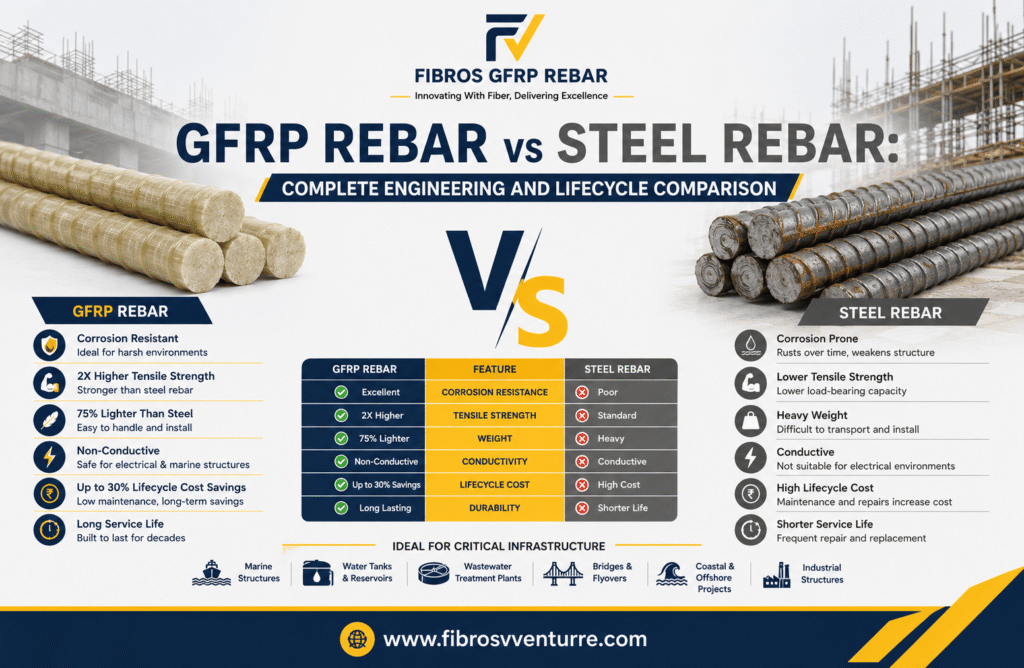
GFRP Rebar vs Steel Rebar: Complete Engineering and Lifecycle Comparison is becoming an increasingly important engineering subject because reinforcement selection is no longer judged only by first cost. Owners and consultants are also considering exposure, maintenance access, expected service conditions, programme risk and the consequences of reinforcement corrosion. GFRP bars are fundamentally different from steel: they are composite reinforcement made from continuous glass fibres embedded in a polymer matrix, and their structural behaviour must be treated according to the governing GFRP design framework rather than by assuming that a steel bar can be replaced one-for-one. This article develops that engineering perspective for gfrp rebar vs steel rebar.
For Indian infrastructure, the discussion around GFRP has moved from a purely novel-material conversation toward standardisation and controlled implementation. BIS has published material and test-method standards for FRP/GFRP reinforcing bars, while the Indian Roads Congress has published IRC:137-2022 for use of GFRP bars in road projects. Those documents do not remove the need for structural design; instead, they give project teams a framework for material qualification, design-property selection, detailing, testing and approval. For gfrp rebar vs steel rebar, the right question is therefore not ‘Is GFRP stronger than steel?’ but ‘Does the selected GFRP system satisfy the required structural and serviceability performance for this element and exposure?’.
The engineering case is most compelling when the structure is exposed to the commercial and construction process, where specification gaps or weak traceability can create technical risk. In such locations, conventional reinforced concrete may demand protective measures and future repair strategies because corrosion of embedded steel can create cracking, delamination, spalling and loss of section after aggressive agents reach the reinforcement. GFRP does not corrode in the electrochemical manner of carbon steel, which changes the durability problem substantially. However, durability of a composite bar still depends on the glass, resin, manufacturing quality, surface treatment, sustained stress, temperature and chemical environment. A competent specification must consider all of these rather than relying on the word ‘non-corrosive’ alone.
From a structural viewpoint, GFRP reinforcement has high tensile capacity but a lower elastic modulus than steel and essentially linear-elastic behaviour to rupture. That combination makes serviceability checks especially important. Deflection, crack width, bar spacing, reinforcement ratio, bond behaviour, development, lap splices and the detailing of bent or transverse reinforcement can govern an efficient design. The selected design code and certified manufacturer data must supply the properties used by the engineer. Generic catalogue values should never be substituted for project design values without verification.
Construction practice is equally important. The performance of a GFRP-reinforced element begins before concrete is placed: bar identification, storage, cutting, tying, supports, cover, lap arrangement, prefabricated bends and inspection all affect whether the installed reinforcement matches the design intent. approved submittals, receiving inspection, storage, bar-mark control, ITP hold points and nonconformance management. Because GFRP is lightweight, handling can be easier, but lightweight reinforcement can also move during concrete placement if the cage is not adequately tied and supported. Site procedures therefore need to be written specifically for GFRP rather than copied unchanged from a steel method statement.
In commercial terms, gfrp rebar vs steel rebar should be evaluated on a lifecycle basis. The initial reinforcement cost is only one line item. Transport, labour, handling, cover requirements, corrosion-protection measures, maintenance closures, access, repair frequency and the owner’s required service period can materially change the comparison. A responsible article must separate documented benefits from project-dependent assumptions. It must also state limitations openly, because technical authority is created by explaining where a material is appropriate and where another solution may be better.
This FIBROS VENTURE Engineering Knowledge Centre chapter is written for structural consultants, EPC contractors, highway and PWD engineers, owners, procurement teams, students and researchers. It provides an engineering framework rather than a substitute for project-specific design. References to standards are intentionally descriptive and do not reproduce copyrighted code clauses. Before issue for construction, the Engineer of Record should verify the current edition of every governing standard, the approved product test data and all project-authority requirements.
Engineering Background and Why This Topic Matters
The engineering purpose of gfrp rebar vs steel rebar is to match reinforcement behaviour to the actual exposure and performance requirement of the structure. For this article, the controlling environment is best described as the commercial and construction process, where specification gaps or weak traceability can create technical risk. The material choice should therefore be linked to a durability mechanism, a structural requirement or an operational constraint that the owner can define and the engineer can verify. Selection based only on novelty or a headline tensile value is not sufficient.
The relevant structural object is the GFRP supply, QA, installation or procurement process. Its load path, restraint, cracking pattern, construction joints, penetrations, support conditions and maintenance access determine where reinforcement is most highly stressed and where deterioration would be most consequential. GFRP changes the reinforcement material, but it does not remove the need to understand concrete behaviour, load combinations, detailing and construction tolerances.
A useful design brief for gfrp rebar vs steel rebar states the required design life, exposure classification, governing standards, concrete performance, loads, serviceability limits, fire or temperature conditions if relevant, and the owner’s inspection and maintenance strategy. Only after these are established should the team compare GFRP with steel or other reinforcement systems. This sequence prevents procurement pressure from driving an engineering decision before the problem has been defined.
The potential value proposition is reliable project delivery by converting engineering intent into auditable procurement and site controls. Whether that value is realised depends on the selected product, design, installation quality and actual exposure. The project should therefore measure success using engineering outcomes such as compliance, crack/deflection performance, absence of reinforcement-related deterioration, reduced maintenance intervention and reliable construction delivery—not simply the quantity of GFRP purchased.
Material Behaviour Relevant to This Application
Design properties
The engineer should define which declared material properties are characteristic, guaranteed, design, environmental-reduction or test values. Mixing values from different manufacturers, diameters or test methods can produce a design that appears precise but is not traceable. A robust calculation package identifies the exact product, diameter range, resin family, surface configuration, test basis and reduction factors used. The same discipline should be reflected in drawings and the technical submittal so that procurement cannot substitute an unverified bar after design.
Serviceability
For GFRP-reinforced concrete, serviceability deserves early attention rather than a final check. The lower elastic modulus compared with steel can increase curvature and crack width for a given reinforcement arrangement. Efficient design therefore considers member depth, reinforcement ratio, spacing, concrete properties and support conditions together. The practical objective is not to force a steel-like reinforcement schedule but to design the concrete/GFRP system as a composite structural solution that satisfies deflection and cracking requirements throughout the intended service condition.
Durability
GFRP avoids electrochemical steel corrosion, but composite durability is still an engineering question. Resin quality, fibre protection, alkaline environment, temperature, moisture, chemicals, sustained load and workmanship can affect long-term behaviour. Exposure assessment should be linked to the project environment and the governing design provisions. Durability claims should be supported by standardised testing, manufacturing control and relevant field evidence rather than by a single accelerated test or a generic statement that all FRP products perform identically.
Bond and anchorage
Bond transfers force between the concrete and the bar through the surface system and mechanical interaction. Different GFRP products can use sand coating, ribs, helically wrapped surfaces or combinations of these features. Development length, lap splices, anchorage zones and local congestion must follow the approved design method and qualified bar system. Site teams should not shorten laps or reposition bars merely because the reinforcement is lightweight. Any field change that alters anchorage should be treated as an engineering change.
Structural Design and Detailing Framework
The key design topics for this application are clear performance requirements, acceptance criteria, traceability, design-property control and responsibility boundaries. These checks should be completed using the governing design standard and the certified design properties of the exact GFRP product. The calculation should distinguish short-term tested properties from design values after applicable reduction factors. The drawings should identify any assumptions that procurement must preserve, such as bar type, surface profile, resin system or factory-formed shape.
GFRP is linear elastic to rupture and does not yield in the same way as conventional reinforcing steel. Design philosophy therefore uses different strength and serviceability relationships, and many members are governed by stiffness, crack control or a deliberately selected failure hierarchy rather than a steel-style yielding assumption. The Engineer of Record must ensure that the chosen code provisions are applicable to the member type and loading condition.
Bar spacing and member depth should be treated as design variables. Increasing reinforcement ratio alone is not always the most efficient response to serviceability because congestion, bond, concrete placement and cost also matter. A balanced design coordinates reinforcement area, concrete section, cover, spacing, load path and construction sequence. The same principle applies to walls, slabs, beams, foundations, barriers, tanks and culverts even though the governing checks differ.
Detailing should be resolved before purchase. Straight bars, closed shapes, U-bars, L-bars, stirrups, rings and custom forms require different manufacturing and inspection controls. Where a bend is part of the design, the approved factory-formed bar should be shown by bar mark and dimension. Site teams should not be left to improvise a shape that cannot be made safely or that changes the reinforcement force path.
Connections, joints and penetrations deserve particular attention because they concentrate construction tolerances and reinforcement demand. The engineer should coordinate waterstops, sleeves, anchor bolts, embeds, construction joints and openings with the reinforcement model. If an element requires conductive continuity, welding, post-installed bending or another steel-specific function, the design should address that requirement explicitly rather than assuming GFRP will behave the same way.
Indian Standards, Authorities and Approval Perspective
For Indian projects, BIS specifications and test methods, consultant approvals, CPWD/PWD practice where applicable, and product-specific certified test data. IS 18256:2023 provides an Indian specification for solid round GFRP bars for concrete reinforcement, while IS 18255:2023 addresses methods of test for FRP bars. For road projects, IRC:137-2022 is a central reference where its scope and the project authority permit the proposed application. The final contract may add more stringent requirements, and those project requirements govern the supply.
A technical submittal should be built as a traceable approval file rather than as a marketing brochure. Typical components include the proposed material specification, manufacturer details, product data, applicable certification, independent laboratory reports, declared design properties, drawings/bar schedule, method statement, inspection and test plan, storage/handling procedure and project references that can be independently verified. The approving Engineer may request additional testing or calculations.
Government and major EPC projects commonly involve several decision layers: designer/consultant, authority or client engineer, contractor, QA laboratory, procurement and site execution. A successful GFRP approval strategy gives each stakeholder the information needed for their responsibility. For example, the designer needs design properties and code basis, QA needs sampling and acceptance criteria, procurement needs unambiguous supply descriptions, and the site team needs installable bar marks and method statements.
The article should not imply that a material is automatically approved throughout NHAI, MoRTH, CPWD, Railways, Metro, PWD or another agency merely because an Indian standard exists. Standards enable specification and verification; project acceptance remains subject to the governing authority, contract, design and approval process. Any project-specific approval claim published by FIBROS should be supported by a document that can be produced if challenged.
International Engineering Perspective
International experience is useful because ACI guidance, ASTM material requirements, FHWA experience and Canadian bridge research. The United States has ACI CODE-440.11-22 for structural concrete reinforced with GFRP bars, and FHWA has documented FRP use and research in bridge infrastructure. Canada has a long body of research and field applications involving GFRP-reinforced bridge decks and barriers. These sources demonstrate that the technology can be engineered systematically, but they should not be copied directly into an Indian design without reconciling standards, loads, materials and authority requirements.
International case studies are most valuable when the article records the owner, location, structural element, year, exposure, reinforcement purpose, design basis, construction method and monitoring/inspection results. Marketing summaries that omit those details are weak evidence. Where a consultant or contractor cannot be verified from an owner or research source, the article should simply say that the information was not confirmed rather than inventing a complete project team.
For India, the objective is to transfer engineering lessons rather than foreign dimensions. Lessons may include how agencies qualified materials, which components were selected first, how reinforcement was inspected, what serviceability issues were monitored and how owners documented long-term performance. This evidence can help Indian authorities frame pilot projects and acceptance plans while keeping the final design fully compliant with Indian project requirements.
Recommended Engineering Workflow
- Define the structural element and exposure for gfrp rebar vs steel rebar, including service life, loads, environmental agents, access and maintenance consequences.
- Identify the governing Indian/project standards and confirm that the proposed GFRP use falls within their scope or has an agreed approval route.
- Select a qualified GFRP product family and obtain current certified properties for the required diameters and shapes.
- Carry out structural analysis and serviceability checks using the approved GFRP design method; do not use a one-for-one steel substitution rule.
- Develop reinforcement drawings and a bar bending schedule that clearly distinguish straight and factory-formed shapes.
- Review constructability with contractor and manufacturer, resolving joints, penetrations, cage stability, delivery lengths and lifting/placement sequence.
- Prepare the material approval package, ITP and sampling/testing plan before bulk procurement.
- Inspect deliveries for quantity, identification, damage and documentation; quarantine material with missing traceability.
- Use a GFRP-specific installation method statement and conduct a documented pre-pour inspection.
- Retain as-built reinforcement records, test reports and photographs for the owner, and monitor performance where the project is a pilot or high-value application.
GFRP vs Conventional Steel: Application Decision Table
| Decision factor | GFRP engineering implication | Conventional steel reference | What it means for this application |
| Corrosion mechanism | No electrochemical rusting like carbon steel; composite durability still requires qualification. | Can corrode if aggressive agents reach the bar; protection/cover/repair strategy may be required. | Strong reason to study GFRP when reinforcement corrosion is a credible lifecycle risk. |
| Elastic stiffness | Lower than steel; deflection and crack control can be important. | Higher modulus; familiar stiffness assumptions. | Do not design by tensile strength alone. |
| Stress-strain behaviour | Essentially linear-elastic to rupture; no conventional steel yielding plateau. | Ductile yielding is central to common reinforced-concrete design philosophy. | Use the governing GFRP design framework and failure hierarchy. |
| Weight/handling | Much lighter by volume than steel; bundles and cages may be easier to move. | Heavier and familiar to conventional crews. | Potential transport/handling benefit, but cages must be restrained during concrete placement. |
| Bending/fabrication | Bent shapes generally require controlled factory manufacture and approved geometry. | Can normally be bent/fabricated using established steel procedures. | Resolve shapes before procurement; do not improvise field bends. |
| Electrical/magnetic behaviour | Non-metallic and generally electrically non-conductive/non-magnetic compared with steel; verify project requirements. | Conductive and ferromagnetic for ordinary carbon steel. | Can be valuable in specialised zones, but do not rely on generic claims without system design. |
| Design familiarity | Requires GFRP-specific code knowledge and product data. | Very mature design and construction ecosystem. | Training and approval planning are part of implementation cost. |
| Lifecycle maintenance | May reduce reinforcement-corrosion-related interventions where correctly designed and installed. | May require corrosion protection/repair depending on exposure. | Use auditable lifecycle assumptions rather than universal savings percentages. |
Construction and Installation
Construction planning for gfrp rebar vs steel rebar should convert design intent into a sequence that can be inspected. The key site priorities are approved submittals, receiving inspection, storage, bar-mark control, ITP hold points and nonconformance management. The method statement should specify unloading, storage, lifting, cutting, identification, tying, supports, cover checks, lap verification, placement around openings and the action to take if a bar is damaged.
Bars should be stored off the ground on supports that prevent deformation, contamination and mix-up between diameters or bar marks. Bundles should remain identified. Lifting should avoid dragging across rough surfaces or using methods that concentrate loads on a small number of bars. If UV/weather protection is specified by the manufacturer for extended storage, the storage plan should include it.
Before concreting, the inspection team should check reinforcement against the latest approved drawing and BBS. Lightweight cages can be easier to position, but they also require secure ties and chairs so they do not float, spread or rotate when concrete is discharged or vibrated. Concrete placement methods should avoid direct impact that damages or displaces the reinforcement.
Nonconforming bars should not be repaired or modified informally. Damage, missing identification, incorrect shape or a requested field bend should trigger the project nonconformance/change process. The designer and manufacturer should determine whether replacement, additional reinforcement or another engineered disposition is acceptable.
Quality Control and Testing
Quality assurance
A project-specific inspection and test plan should connect purchase requirements to receiving inspection, certificates, laboratory tests and installation hold points. Traceability should allow installed reinforcement to be linked back to a production batch or delivery lot. Test reports should identify the standard, specimen/bar size, conditioning, laboratory and results. If project acceptance relies on third-party testing, the scope and sampling frequency should be agreed before shipment so that commercial pressure does not weaken the technical acceptance process.
Procurement
Procurement should ask for more than a rate per kilogram. A technically complete inquiry identifies bar diameters, lengths, shapes, quantities, design standard, required certificates, test reports, packaging, bar-mark system, delivery sequence and any restrictions on substitutions. Bent shapes should be ordered from approved drawings. The commercial comparison should also recognise that GFRP and steel have different densities, so cost-per-kilogram is rarely a meaningful standalone comparison for an installed reinforcement system.
| QA Stage | Minimum Control | Evidence to Retain |
| Design approval | Approved calculations, drawings, design properties and governing standards | Signed/approved design package and revision register |
| Vendor qualification | Manufacturer information, product technical data, relevant certification and independent tests | Approved vendor/material submittal |
| Manufacturing/lot control | Bar size/shape, identification, production traceability and required factory tests | Batch/lot records and certificates |
| Receiving inspection | Quantity, size, bar mark, visible damage, packing and documents | GRN/inspection report and photographs |
| Pre-pour inspection | Spacing, cover, laps, bends, supports, openings and cage stability | Checklist, marked-up drawing and photographs |
| Post-construction record | As-built changes, test reports and nonconformance close-out | Owner handover dossier |
Lifecycle Cost and Owner Decision Framework
A lifecycle comparison for gfrp rebar vs steel rebar should start with the owner’s actual problem. If the element is in a benign indoor environment with easy access and little corrosion risk, the economic justification may be different from an element exposed to chlorides, chemicals, groundwater or repeated wetting. The analysis should therefore be exposure-specific, not a universal GFRP-versus-steel slogan.
Initial costs should include design effort, reinforcement supply, fabrication, freight, handling, supports/ties, installation, testing and any authority approval requirements. Steel alternatives should include their own corrosion-protection system where required. Future costs can include inspection, crack/spall repair, traffic management or production shutdown, access/scaffolding, replacement and user disruption. Each future intervention needs a transparent timing and cost assumption.
For public communication, report a range or sensitivity analysis rather than a guaranteed saving percentage unless the project has a documented tender/lifecycle study. If FIBROS publishes a cost case study, it should show quantities, unit basis, dates, exclusions and source of the rates. That transparency makes the article useful to consultants and protects the company from exaggerated marketing claims.
Common Mistakes to Avoid
- Omitting traceability between delivered bundles, test certificates and installed bar marks.
- Assuming that non-corrosive means unlimited resistance to every chemical, temperature or sustained-load condition.
- Using insufficient chairs, ties or braces and allowing lightweight cages to move during concreting.
- Copying cover, lap and development details from steel practice without checking the approved GFRP design basis.
- Publishing project names, savings percentages or approval claims without documents that can be verified.
- Using a steel reinforcement drawing and changing only the material name without recalculating serviceability, strength, bond and detailing.
- Quoting one generic tensile-strength value for every diameter, product and manufacturing batch.
- Allowing unapproved field bending, heating or reshaping of bars.
- Failing to identify factory-formed bends clearly in the bar bending schedule.
- Comparing GFRP and steel only by price per kilogram instead of installed structural function.
Practical Tips by Stakeholder
Contractor Tips
- Request a GFRP-specific method statement before mobilisation.
- Coordinate bent shapes and congestion before manufacturing.
- Use a pre-pour checklist with photographs and bar-mark verification.
- Provide enough cage bracing to prevent movement during concrete placement.
- Escalate field changes affecting laps, anchorage, bends or openings to the engineer.
Consultant Tips
- State the exact design standard and product properties used in calculations.
- Check serviceability early; do not wait until final reinforcement is selected.
- Detail corners, openings, laps and bent shapes explicitly.
- Define acceptance documents and independent testing in the specification.
- Record assumptions and limitations so procurement substitutions cannot invalidate the design.
Procurement Tips
- Issue enquiries using diameter, length, shape, quantity and required standards.
- Ask for traceable test reports rather than brochures alone.
- Separate straight bars, bent shapes and special cages in the commercial schedule.
- Check packing, delivery sequence and identification requirements.
- Compare total installed/lifecycle value rather than rate per kilogram only.
Owner Tips
- Identify the exposure and maintenance problem the reinforcement choice is intended to solve.
- Require an auditable lifecycle analysis for major cost-saving claims.
- Retain as-built product and test data for future asset management.
- Use pilot applications where organisational experience is limited.
- Track performance and maintenance outcomes so future specifications are evidence-based.
Case Study and Evidence Perspective
For gfrp rebar vs steel rebar, the strongest case study would document a real project with the same structural element and exposure. The minimum evidence should include location, owner, year, element, reason for selecting GFRP, design basis, reinforcement description, construction method and an owner/research source. If such evidence is not available for a specific claim, use an explicitly labelled engineering scenario or original diagram instead of presenting an illustrative example as a real project.
FIBROS should maintain a case-study evidence register containing source links, permission status for photographs, project contacts that are genuinely public, and the exact wording that can be supported. This protects technical credibility and makes future handbook compilation much easier.
Application-Specific Engineering Priority Matrix
| Priority | Engineering Issue | Required Action | Primary Owner |
| 1 | Material traceability | Confirm how material traceability affects gfrp rebar vs steel rebar and record the design/QA response. | Designer / QA / Contractor as applicable |
| 2 | Tensile behaviour | Confirm how tensile behaviour affects gfrp rebar vs steel rebar and record the design/QA response. | Designer / QA / Contractor as applicable |
| 3 | Elastic modulus and serviceability | Confirm how elastic modulus and serviceability affects gfrp rebar vs steel rebar and record the design/QA response. | Designer / QA / Contractor as applicable |
| 4 | Bond with concrete | Confirm how bond with concrete affects gfrp rebar vs steel rebar and record the design/QA response. | Designer / QA / Contractor as applicable |
| 5 | Durability | Confirm how durability affects gfrp rebar vs steel rebar and record the design/QA response. | Designer / QA / Contractor as applicable |
| 6 | Resin and fibre quality | Confirm how resin and fibre quality affects gfrp rebar vs steel rebar and record the design/QA response. | Designer / QA / Contractor as applicable |
Extended Engineering Notes
Installation – Application Note 1
In the context of gfrp rebar vs steel rebar, GFRP bars should be protected from unnecessary abrasion, impact and contamination during storage and installation. Cutting methods and PPE should follow the manufacturer method statement and project safety plan. Bars should be supported so that cover and spacing remain within tolerance during the pour. Chairs, ties and temporary braces must not create damage or uncontrolled movement. A pre-pour inspection should verify bar mark, size, spacing, laps, bends, openings, cover and cleanliness, with photographs retained in the QA record. The practical interpretation should be tied to the commercial and construction process, where specification gaps or weak traceability can create technical risk. A project team should record the decision in a way that can be checked by the designer, QA team, contractor and owner. Where the proposed detail differs from established steel practice, the drawing or method statement should explain the reason and identify the approving engineer. For procurement, the same requirement should appear in the purchase description so that a technically different product cannot be substituted on the basis of diameter or rate alone. For construction, the inspection checklist should convert the requirement into an observable site condition. For handover, the final dossier should preserve evidence of what was supplied and installed. This chain from design to as-built record is especially important for a developing material category because future owners and engineers may need to understand why GFRP was selected and which product properties were assumed.
Quality assurance – Application Note 2
In the context of gfrp rebar vs steel rebar, A project-specific inspection and test plan should connect purchase requirements to receiving inspection, certificates, laboratory tests and installation hold points. Traceability should allow installed reinforcement to be linked back to a production batch or delivery lot. Test reports should identify the standard, specimen/bar size, conditioning, laboratory and results. If project acceptance relies on third-party testing, the scope and sampling frequency should be agreed before shipment so that commercial pressure does not weaken the technical acceptance process. The practical interpretation should be tied to the commercial and construction process, where specification gaps or weak traceability can create technical risk. A project team should record the decision in a way that can be checked by the designer, QA team, contractor and owner. Where the proposed detail differs from established steel practice, the drawing or method statement should explain the reason and identify the approving engineer. For procurement, the same requirement should appear in the purchase description so that a technically different product cannot be substituted on the basis of diameter or rate alone. For construction, the inspection checklist should convert the requirement into an observable site condition. For handover, the final dossier should preserve evidence of what was supplied and installed. This chain from design to as-built record is especially important for a developing material category because future owners and engineers may need to understand why GFRP was selected and which product properties were assumed.
Frequently Asked Questions
Q1. How should GFRP be cut?
Use the approved manufacturer/site method, appropriate cutting equipment and PPE. Cutting should avoid uncontrolled fibre damage, and cut pieces must remain traceable to the bar schedule where required. For this article, apply that principle specifically to gfrp rebar vs steel rebar and confirm the project-specific design and approval basis.
Q2. Can normal steel tying wire be used?
The tying system should be selected to suit the project exposure and specification. The objective is to hold the cage securely without damaging the GFRP or creating an unwanted corrosion/electrical detail. Follow approved drawings and method statements. For this article, apply that principle specifically to gfrp rebar vs steel rebar and confirm the project-specific design and approval basis.
Q3. Is GFRP suitable for marine concrete?
Marine and chloride exposure is one of the important application areas for non-corrosive reinforcement, but the member still requires structural, serviceability, durability and constructability design for the specific environment. For this article, apply that principle specifically to gfrp rebar vs steel rebar and confirm the project-specific design and approval basis.
Q4. Is GFRP suitable for bridges?
Yes, GFRP reinforcement has documented bridge applications internationally, particularly in decks and barriers. Indian road use should follow the applicable IRC/MoRTH/project requirements and approved structural design. For this article, apply that principle specifically to gfrp rebar vs steel rebar and confirm the project-specific design and approval basis.
Q5. Which Indian standards are relevant?
IS 18256:2023 addresses solid round GFRP bars for concrete reinforcement and IS 18255:2023 addresses test methods for FRP bars. IRC:137-2022 provides guidance for GFRP bars in road projects. Always check current editions and project-specific requirements. For this article, apply that principle specifically to gfrp rebar vs steel rebar and confirm the project-specific design and approval basis.
Q6. What should a GFRP test certificate show?
At minimum it should clearly identify the product, bar size, batch or traceability reference, test standard/method, laboratory, relevant measured properties and dates. Project specifications may require additional information. For this article, apply that principle specifically to gfrp rebar vs steel rebar and confirm the project-specific design and approval basis.
Q7. Why does the surface profile matter?
The bar surface participates in bond and force transfer between concrete and reinforcement. Sand coating, ribs, wraps and other profiles are not interchangeable unless the design and qualification data demonstrate the required performance. For this article, apply that principle specifically to gfrp rebar vs steel rebar and confirm the project-specific design and approval basis.
Q8. How should GFRP be stored?
Store it on suitable supports in an organised way that prevents damage, contamination and loss of identification. Follow manufacturer requirements for outdoor exposure, stacking and lifting. For this article, apply that principle specifically to gfrp rebar vs steel rebar and confirm the project-specific design and approval basis.
Q9. Does lighter weight automatically reduce total project cost?
Not automatically. Lower mass can reduce transport and handling effort, but installed cost also depends on design quantity, shapes, labour, supply chain, testing, programme and lifecycle assumptions. For this article, apply that principle specifically to gfrp rebar vs steel rebar and confirm the project-specific design and approval basis.
Q10. Can GFRP be used in foundations?
It can be considered in foundation elements within the scope of the governing design requirements, particularly where corrosion exposure is important. Foundation design must still address punching, shear, flexure, development, serviceability and construction loading. For this article, apply that principle specifically to gfrp rebar vs steel rebar and confirm the project-specific design and approval basis.
Q11. What is the biggest procurement mistake?
Buying only on price or a generic tensile-strength claim. Procurement should tie the supplied product to approved design properties, test evidence, bar sizes, surface system, resin, traceability and drawings. For this article, apply that principle specifically to gfrp rebar vs steel rebar and confirm the project-specific design and approval basis.
Q12. What is the biggest site mistake?
Treating GFRP exactly like steel without an approved method statement. Common risks include unapproved bending, poor cage restraint, bar damage, incorrect laps, lost bar identification and movement during concreting. For this article, apply that principle specifically to gfrp rebar vs steel rebar and confirm the project-specific design and approval basis.
Q13. Can GFRP reduce concrete cover?
Cover is a design and code matter, not a universal marketing claim. The governing standard, durability/fire requirements, bond, construction tolerances and project authority determine the required cover. For this article, apply that principle specifically to gfrp rebar vs steel rebar and confirm the project-specific design and approval basis.
Q14. How should owners compare GFRP and steel?
Use a project-specific whole-life comparison: structural design, installed quantity, transport, labour, protection systems, maintenance, access, disruption and expected service period. Document assumptions and test sensitivity. For this article, apply that principle specifically to gfrp rebar vs steel rebar and confirm the project-specific design and approval basis.
Q15. Who should approve the final GFRP design?
The Engineer of Record and the relevant project authority should approve the final structural design, material submittal and construction documents in accordance with the contract and governing regulations. For this article, apply that principle specifically to gfrp rebar vs steel rebar and confirm the project-specific design and approval basis.
Q16. Can GFRP rebar be used as a direct one-for-one replacement for steel?
Normally, no. GFRP has different stiffness, stress-strain behaviour, bond characteristics and design rules. A qualified structural engineer should redesign or verify the member using the governing GFRP standard and certified properties of the selected bar. For this article, apply that principle specifically to gfrp rebar vs steel rebar and confirm the project-specific design and approval basis.
Q17. Does GFRP rebar rust?
GFRP does not undergo the electrochemical rusting mechanism of carbon steel. That is a major reason for considering it in chloride, marine and wet environments. Composite durability still depends on resin, fibres, manufacturing quality, exposure, sustained stress and temperature. For this article, apply that principle specifically to gfrp rebar vs steel rebar and confirm the project-specific design and approval basis.
Q18. Is GFRP always stronger than steel?
A simple strength comparison is misleading. GFRP can have high tensile strength, but its elastic modulus, rupture behaviour and design factors differ from steel. Structural suitability depends on the complete member design, not one tensile number. For this article, apply that principle specifically to gfrp rebar vs steel rebar and confirm the project-specific design and approval basis.
Q19. Why is deflection important with GFRP?
Because the elastic modulus of GFRP is lower than that of steel, member stiffness and cracking behaviour can control design. Deflection and crack-width checks should be carried out using the applicable GFRP design method. For this article, apply that principle specifically to gfrp rebar vs steel rebar and confirm the project-specific design and approval basis.
Q20. Can GFRP bars be bent on site?
Field bending should not be assumed acceptable. Bent GFRP shapes are normally produced under controlled manufacturing conditions. Use only approved factory-formed shapes and follow the manufacturer and project specification. For this article, apply that principle specifically to gfrp rebar vs steel rebar and confirm the project-specific design and approval basis.
Conclusion
GFRP Rebar vs Steel Rebar: Complete Engineering and Lifecycle Comparison should be approached as an engineering decision, not as a material slogan. The strongest use case is where the project can clearly connect the reinforcement choice to reliable project delivery by converting engineering intent into auditable procurement and site controls, while still satisfying structural strength, serviceability, bond, detailing, constructability, quality and authority requirements. GFRP brings important differences from steel; those differences are the reason it can solve certain durability or functional problems, and also the reason it must be designed with its own standards and verified product properties.
For consultants and owners, the next step is to define the element, exposure, required design life and governing code, then evaluate a qualified product using project-specific calculations. For contractors and procurement teams, the next step is to convert approved design properties into an auditable supply and installation package. FIBROS VENTURE should position itself in this process as an engineering-information partner: provide clear technical data, traceable test evidence, buildable shapes and honest limitations, and allow the Engineer of Record to make the final structural decision.