Reinforcement selection is no longer based only on the initial purchase price of a bar. For bridges, highways, water-retaining structures, coastal facilities, industrial plants and other long-life concrete assets, owners and consultants must also consider exposure conditions, maintenance access, design life, construction risk and the future consequences of reinforcement corrosion.
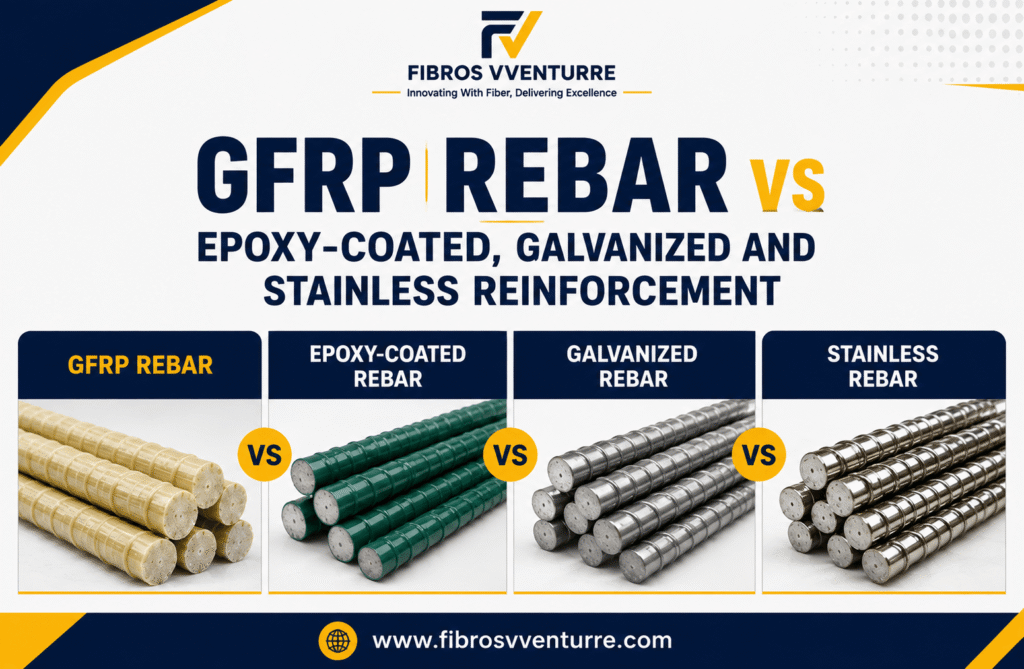
This makes the comparison between GFRP rebar, epoxy-coated steel, galvanized steel and stainless-steel reinforcement increasingly important.
GFRP, or Glass Fibre Reinforced Polymer, is fundamentally different from steel-based reinforcement systems. It is a composite bar manufactured from continuous glass fibres embedded in a polymer resin matrix. It therefore requires GFRP-specific material properties, design procedures, serviceability checks, detailing rules and quality controls. It should not be treated as a direct one-for-one replacement for steel merely because the bars appear similar in shape.
Why Reinforcement Corrosion Matters
Conventional reinforced concrete may experience deterioration when moisture, chlorides or aggressive chemicals reach embedded steel. Over time, corrosion products may contribute to cracking, delamination, spalling and loss of reinforcement section.
Corrosion-protection systems are therefore selected according to the severity of exposure and the owner’s service-life expectations.
Epoxy-coated steel relies on a protective coating around conventional steel. Galvanized reinforcement uses a metallic protective coating. Stainless-steel reinforcement obtains its corrosion resistance from its alloy composition. GFRP follows a different approach because it is a non-metallic composite and does not undergo the electrochemical rusting mechanism associated with carbon steel.
However, the term non-corrosive should not be interpreted as meaning that every GFRP product has unlimited durability in every environment. Long-term performance still depends on the glass fibre, resin formulation, manufacturing quality, surface system, temperature, moisture, chemicals and sustained loading. Durability claims should therefore be supported by standardized testing, traceable manufacturing records and project-specific evaluation.
Understanding the Reinforcement Options
GFRP Rebar
GFRP rebar is lightweight, non-metallic and generally non-magnetic and electrically non-conductive compared with ordinary carbon steel. It can provide high tensile capacity, but it normally has a lower elastic modulus than steel.
Its tensile response is essentially linear-elastic up to rupture. Unlike conventional steel, it does not provide a traditional yielding plateau. This difference affects the design philosophy and makes deflection, crack control, bond, reinforcement ratio and failure mode particularly important.
Epoxy-Coated Steel
Epoxy-coated reinforcement is conventional steel covered with a protective polymer coating. It retains the familiar stiffness and yielding behaviour of steel while using the coating as a barrier against aggressive agents.
Its effectiveness depends heavily on coating continuity and site handling. Damage during unloading, storage, cutting, tying, fabrication or installation may reduce the intended protection. Inspection and repair procedures must therefore follow the project specification.
Galvanized Steel
Galvanized reinforcement is steel protected by a metallic coating. It retains conventional steel behaviour and provides an additional level of corrosion resistance compared with unprotected carbon-steel reinforcement.
Its performance depends on the coating system, fabrication quality, exposure conditions and project requirements. The reinforcement should be procured and installed according to the applicable specification rather than treated as ordinary uncoated steel.
Stainless-Steel Reinforcement
Stainless-steel reinforcement provides high corrosion resistance while retaining steel-like stiffness and ductility. It may be considered for severe exposure conditions, long design lives or locations where future repair would be difficult and costly.
The grade and suitability of stainless reinforcement must be selected according to the actual environment, structural requirements and project specification.
Engineering Comparison
| Decision Factor | GFRP Rebar | Epoxy-Coated Steel | Galvanized Steel | Stainless Steel |
|---|---|---|---|---|
| Basic material | Glass fibres and polymer resin | Coated carbon steel | Metallic-coated steel | Corrosion-resistant steel alloy |
| Corrosion approach | Non-metallic reinforcement | Protective barrier coating | Protective metallic coating | Alloy-based resistance |
| Tensile behaviour | Linear-elastic to rupture | Conventional steel yielding | Conventional steel yielding | Steel-like yielding |
| Elastic modulus | Lower than steel | High | High | High |
| Weight | Significantly lighter than steel | Similar to conventional steel | Similar to conventional steel | Similar to conventional steel |
| Field bending | Generally avoided; use approved factory-formed shapes | Subject to coating requirements | Subject to approved fabrication requirements | Conventional fabrication procedures |
| Main design concern | Serviceability, bond and GFRP-specific detailing | Coating integrity | Coating and fabrication control | Grade selection and cost |
| Lifecycle potential | Strong where corrosion-related maintenance is a major risk | Exposure and coating dependent | Exposure and coating dependent | Strong durability with steel-like behaviour |
This comparison shows why tensile strength alone cannot determine the most suitable reinforcement. GFRP may have high tensile capacity, but its lower stiffness can make deflection and crack width controlling design considerations.
Structural Design and Serviceability
GFRP reinforcement must be designed as part of a complete concrete–GFRP structural system.
The Engineer of Record should verify:
- Flexural strength
- Deflection
- Crack width
- Shear and punching
- Development length
- Lap splices
- Bond and anchorage
- Reinforcement spacing
- Required failure hierarchy
A steel reinforcement drawing should not be converted into a GFRP drawing by changing only the material name. The member must be recalculated using the governing GFRP design framework and certified properties of the selected product.
Serviceability should be checked early. Because GFRP normally has a lower elastic modulus than steel, an efficient solution may require adjustment of member depth, reinforcement ratio, bar spacing or concrete properties.
Bond is also product-specific. GFRP bars may use sand-coated, ribbed, helically wrapped or combined surface profiles. These systems should not be assumed interchangeable. Development lengths, lap lengths and anchorage details must follow the approved bar system and design method.
Bent Bars, Stirrups and Custom Shapes
Straight GFRP bars, L-bars, U-bars, stirrups, rings and other custom shapes require different manufacturing and inspection controls.
Where a bend is required, the approved factory-formed shape should be shown clearly in the reinforcement drawing and bar schedule. Site teams should not heat, reshape or bend GFRP bars unless the method has been specifically approved.
Epoxy-coated and galvanized reinforcement may also require controlled fabrication so that the protective coating is not damaged. Stainless reinforcement generally follows steel fabrication practices, but the approved grade and handling requirements must still be maintained.
Indian Standards and Project Approval
For Indian projects, the source manuscript identifies the following important references:
- IS 18256:2023 for solid round GFRP bars for concrete reinforcement
- IS 18255:2023 for FRP bar testing methods
- IRC:137-2022 for the use of GFRP bars in road projects where applicable
These documents support material qualification, testing, design-property selection and controlled implementation. However, the existence of an Indian standard does not mean that every GFRP product is automatically accepted for every NHAI, MoRTH, CPWD, PWD, Railway, Metro or private-sector project.
Approval remains subject to the governing authority, contract conditions, structural consultant, certified product data and project-specific technical submittal.
A complete approval package should normally include product data, manufacturer information, independent test reports, certified properties, drawings, bar schedules, method statements, inspection plans and traceability records.
Construction and Installation
GFRP’s low weight can simplify transportation and manual handling, but lightweight reinforcement cages must be securely supported so they do not float, spread, rotate or move during concreting.
A GFRP-specific method statement should address:
- Unloading and storage
- Bar identification
- Approved cutting tools
- Personal protective equipment
- Tying and supporting
- Concrete-cover control
- Lap and anchorage verification
- Placement around openings
- Pre-pour inspection
- Handling of damaged bars
Bars should be stored above the ground, protected from unnecessary abrasion and kept traceable by diameter, bar mark and batch.
Before concrete placement, the inspection team should verify the latest approved drawing, reinforcement spacing, cover, lap lengths, factory-formed bends, supports and cage stability. Damaged or unidentified bars should be quarantined rather than repaired informally.
Quality Assurance and Procurement
Procurement should not compare GFRP, epoxy-coated steel, galvanized steel and stainless steel only by price per kilogram.
A technically complete purchase inquiry should identify:
- Bar diameter and length
- Straight or bent shape
- Surface profile, coating or grade
- Applicable specification
- Certified design properties
- Test requirements
- Batch or lot traceability
- Packaging and identification
- Delivery sequence
- Restrictions on substitutions
GFRP and steel have different densities, design quantities and installation requirements. Therefore, price per kilogram is rarely a meaningful standalone comparison.
The inspection and test plan should connect design approval, vendor qualification, manufacturing records, receiving inspection, laboratory testing, pre-pour inspection and final handover documentation.
Lifecycle Cost Comparison
The lowest initial reinforcement rate does not always produce the lowest whole-life cost.
A lifecycle comparison should include:
- Design and approval
- Material supply
- Fabrication
- Freight and handling
- Installation
- Testing
- Corrosion-protection measures
- Inspection and maintenance
- Repair access
- Traffic diversion or operational shutdown
- Future replacement
- User disruption
GFRP may provide strong lifecycle value where chlorides, chemicals, groundwater, wetting and drying, or restricted maintenance access create a serious corrosion risk.
Stainless steel may also offer strong durability where steel-like behaviour is required. Epoxy-coated and galvanized reinforcement may offer suitable intermediate solutions, depending on exposure and workmanship.
Project teams should publish auditable calculations or sensitivity ranges rather than universal saving percentages.
Common Mistakes to Avoid
Common mistakes include:
- Replacing steel with GFRP without redesign
- Comparing reinforcement only by price per kilogram
- Using generic tensile values without traceability
- Ignoring deflection and crack control
- Allowing unapproved field bending
- Failing to identify factory-formed shapes
- Damaging protective coatings during handling
- Using insufficient chairs and cage restraints
- Publishing unsupported approval or savings claims
- Losing the connection between test certificates and installed bar marks
Conclusion
GFRP, epoxy-coated steel, galvanized steel and stainless-steel reinforcement are not interchangeable products. Each offers a different balance of structural behaviour, corrosion resistance, constructability, quality assurance and lifecycle cost.
GFRP provides a lightweight, non-metallic reinforcement solution that can reduce dependence on corrosion-related repairs when it is properly designed, manufactured, tested and installed. Epoxy-coated and galvanized reinforcement retain familiar steel behaviour but depend on the integrity of their protective systems. Stainless reinforcement combines corrosion resistance with steel-like behaviour, although its economic suitability must be assessed for each project.
The final decision should be based on the structural element, exposure, required design life, serviceability limits, approval route, construction method and lifecycle requirements—not on a material slogan.
FIBROS VENTURE should position GFRP as an engineered reinforcement solution supported by verified properties, traceable test evidence, buildable shapes and clear technical limitations, while allowing the Engineer of Record to make the final project-specific decision.