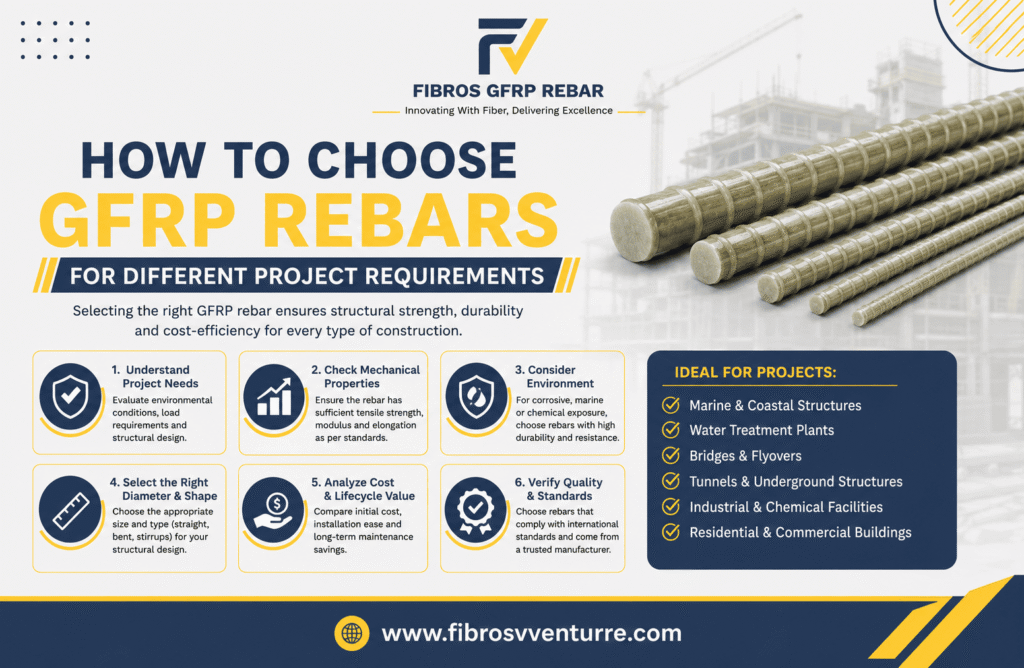
Choosing GFRP rebar is not simply a matter of selecting a diameter and comparing prices. The correct product must satisfy the structural design, environmental exposure, construction method and approval requirements of the project.
Glass Fiber Reinforced Polymer reinforcement is increasingly considered for concrete structures where corrosion resistance, low weight or nonmetallic reinforcement is important. However, different GFRP bars can have different resin systems, surface profiles, mechanical properties, bend capabilities and quality-control documentation.
A product that is suitable for an industrial floor may not automatically be suitable for a bridge deck, water tank, retaining wall or marine structure.
This practical guide explains the key points that engineers, contractors, consultants and procurement teams should examine before selecting GFRP reinforcement.
1. Begin with the Project’s Structural Requirements
The first step is to understand what the reinforcement is expected to do inside the concrete member.
Review the approved structural drawings and identify:
- Type of structural member
- Design loads
- Required bar diameters
- Required spacing
- Concrete cover
- Development and anchorage requirements
- Lap-splice requirements
- Crack-width limits
- Deflection limits
- Required straight and bent-bar shapes
GFRP reinforcement should not be selected by directly replacing steel bars with GFRP bars of the same diameter.
GFRP and steel differ in stiffness, failure behaviour, bond characteristics, development requirements and temperature response. ACI CODE-440.11-22 provides GFRP-specific requirements for structural analysis, strength, serviceability, deflection, reinforcement development, splicing, detailing and inspection.
The project’s qualified structural engineer should therefore approve the selected bar size, spacing, quantity and detailing.
2. Evaluate the Environmental Exposure
The surrounding environment is one of the most important reasons for considering GFRP reinforcement.
Project teams should determine whether the concrete will be exposed to:
- Seawater
- Coastal salt spray
- Chlorides
- De-icing salts
- Groundwater
- Continuous moisture
- Sewage or wastewater
- Industrial chemicals
- Elevated service temperatures
- Repeated wet and dry cycles
GFRP does not rust through the same electrochemical process as carbon-steel reinforcement. This makes it particularly attractive where steel corrosion could reduce the service life of the structure.
Typical corrosion-sensitive applications include:
- Marine structures
- Coastal foundations
- Bridge decks
- Drainage structures
- Water-treatment facilities
- Wastewater plants
- Chemical industries
- Retaining walls
- Underground structures
However, the phrase “corrosion-resistant” should not be treated as proof that every GFRP product is suitable for every environment.
The resin system, glass fibers, manufacturing quality, degree of cure, glass-transition temperature and durability test results should be reviewed for the actual exposure conditions.
3. Confirm the Applicable Standard
Before purchasing, identify the material specification, design code and construction requirements applicable to the project.
ASTM D7957/D7957M-25 covers solid, round GFRP bars supplied in straight cut lengths and bent shapes with an enhanced external surface. It addresses geometric, physical and mechanical properties, qualification, quality control and certification.
The specification includes requirements relating to:
- Bar dimensions
- Fiber mass content
- Glass-transition temperature
- Degree of cure
- Ultimate tensile force
- Tensile modulus
- Ultimate tensile strain
- Transverse shear strength
- Bond strength
- Minimum inside bend diameter
ACI CODE-440.11-22 provides minimum design and detailing requirements for qualifying GFRP-reinforced concrete structures. ACI SPEC-440.5-22 addresses construction matters such as delivery, storage, handling, fabrication, installation and repair.
Indian infrastructure projects may also require project-specific specifications, authority approvals, consultant acceptance and applicable Indian or international test documentation.
The tender documents and technical specifications should clearly state which standards and editions govern the project.
4. Compare Guaranteed Properties, Not Only Typical Values
Product brochures often show impressive mechanical values, but buyers should understand whether those figures are:
- Typical laboratory results
- Average values
- Minimum guaranteed values
- Design values
- Values after environmental reduction
- Values applicable to every diameter or only selected sizes
For engineering approval, minimum guaranteed properties are generally more useful than promotional averages.
The technical data sheet should clearly identify:
Tensile strength
This indicates the bar’s capacity under longitudinal tension.
A high tensile-strength value alone does not establish that the bar is suitable for the project. The engineer must also consider stiffness, strain, bond and applicable design reduction factors.
Tensile modulus of elasticity
The modulus indicates the stiffness of the bar.
GFRP generally has a lower modulus than conventional reinforcing steel. Consequently, deflection and crack-width requirements may influence the amount and spacing of reinforcement.
Ultimate tensile strain
This indicates the strain reached before tensile rupture under the specified test conditions.
Transverse shear strength
GFRP is direction-dependent. Its longitudinal tensile strength should not be assumed to represent its performance under transverse or shear loading.
Bond strength
Bond allows forces to transfer between the concrete and reinforcing bar. The bar’s external surface, concrete strength, cover, spacing and development length all affect this interaction.
ASTM D7957/D7957M-25 includes tensile, modulus, strain, transverse shear and bond properties within its qualification and production requirements.
5. Select the Correct Bar Diameter
The required diameter should come from structural calculations, not from a simple steel-to-GFRP substitution.
When evaluating available sizes, confirm:
- Nominal diameter
- Measured diameter
- Nominal cross-sectional area
- Guaranteed properties for that specific size
- Weight per metre
- Available production length
- Permitted dimensional tolerances
- Packaging quantity
- Availability of matching bent shapes
Mechanical properties may vary between diameters. Do not assume that the values shown for one size automatically apply to the entire product range.
The supplier’s technical submission should provide size-specific data.
6. Examine the Surface Profile
The external surface of a GFRP bar is critical to its interaction with concrete.
Common surface configurations include:
- Helically wrapped bars
- Sand-coated bars
- Ribbed or deformed bars
- Wrapped and sand-coated bars
- Manufacturer-specific combined profiles
The buyer should request:
- A close-up product photograph
- Surface-profile description
- Nominal dimensions
- Bond-test documentation
- Confirmation that the tested product matches the supplied product
A visually aggressive surface is not automatically proof of superior bond. Performance should be supported by testing according to the applicable specification.
ASTM D7957/D7957M-25 applies to bars with external surface enhancement and includes bond strength among the specified mechanical properties.
7. Review the Resin System and Manufacturing Quality
The polymer resin binds the glass fibers, maintains the bar’s shape and transfers stress within the composite.
Ask the supplier to identify:
- Resin type
- Fiber type
- Fiber mass content
- Glass-transition temperature
- Degree of cure
- Manufacturing process
- Production quality-control procedures
ACI CODE-440.11-22 applies to GFRP bars meeting its stated material scope and requirements. The structural engineer should verify that the proposed product falls within the scope of the selected design standard.
Manufacturing consistency is equally important. A technically strong sample does not guarantee that every production batch will perform identically.
Request evidence of:
- Raw-material inspection
- Process-control records
- Finished-product inspection
- Lot identification
- Batch traceability
- Periodic mechanical testing
- Calibration of testing equipment
- Certificate of conformity
8. Determine Whether Straight or Bent GFRP Bars Are Needed
Many projects require both straight bars and shaped reinforcement.
Common factory-manufactured shapes include:
- L-bars
- U-bars
- Stirrups
- Links
- Rings
- Spirals
- Corner bars
- Hairpin bars
- Project-specific shapes
Bent GFRP bars should be ordered according to approved drawings or a Bar Bending Schedule.
The supplier should receive:
- Bar diameter
- Shape drawing
- Bend angle
- Inside bend radius
- Leg lengths
- Quantity
- Dimensional tolerance
- Required delivery sequence
Straight GFRP bars should not be casually heated or bent into sharp shapes at the construction site.
ASTM D7957/D7957M-25 includes both straight cut lengths and bent shapes and specifies minimum inside-bend requirements.
Bent-region properties can differ from the properties of the straight portion. Product qualification and bend-location test information should therefore be reviewed when bent reinforcement performs a structural function.
9. Check Fire and Temperature Requirements
The polymer component of GFRP responds differently to elevated temperature than steel.
Before selecting GFRP reinforcement, determine:
- Required fire-resistance rating
- Expected service temperature
- Concrete-cover requirements
- Resin glass-transition temperature
- Exposure to hot equipment or processes
- Emergency fire conditions
GFRP should not be described as fireproof.
Fire resistance must be evaluated as part of the complete concrete member, considering the applicable code, concrete cover, material properties and project-specific exposure.
ACI’s GFRP code and training programme include requirements and guidance relating to fire, elevated temperature and structural analysis.
10. Consider Handling and Installation
Correct product selection can be undermined by poor storage or installation.
The project method statement should address:
- Unloading procedure
- Storage above the ground
- Protection from mechanical damage
- Protection from unnecessary prolonged exposure
- Recommended cutting tools
- Personal protective equipment
- Bar supports and chairs
- Tying materials
- Placement tolerances
- Pre-concrete inspection
- Repair or rejection of damaged bars
GFRP bars are lightweight, but they should still be handled carefully. Dragging bars over rough surfaces, dropping heavy objects onto them or forcing them into position can damage the surface or fibers.
ACI SPEC-440.5-22 addresses construction with GFRP reinforcement, while ACI’s handling and placement guidance highlights the differences between GFRP and conventional steel detailing and construction practices.
11. Review the Complete Technical Submission
Before issuing approval or a purchase order, request a documented technical package.
A strong submission should include:
1. Product technical data sheet
2. Applicable material standard
3. Test reports from a competent laboratory
4. Diameter-wise mechanical properties
5. Surface-profile description
6. Resin-system information
7. Fiber-content information
8. Glass-transition-temperature results
9. Degree-of-cure results
10. Tensile test results
11. Tensile modulus and strain data
12. Bond-test results
13. Transverse shear results
14. Durability test information
15. Bent-bar data where applicable
16. Quality-control plan
17. Batch-traceability procedure
18. Certificate of conformity
19. Handling and installation guide
20. Previous project references where available
Verify that the product name, diameter, batch and manufacturing location shown in the reports correspond to the material proposed for supply.
12. Compare Total Project Value, Not Only Purchase Price
The lowest rate per kilogram or metre may not represent the best overall value.
A proper commercial comparison should consider:
- Required reinforcement quantity
- Transportation cost
- Handling cost
- Installation time
- Availability of factory-bent shapes
- Material wastage
- Technical-support capability
- Delivery reliability
- Testing and approval documentation
- Expected exposure conditions
- Potential corrosion-related maintenance
GFRP and steel have different densities, design properties and reinforcement requirements. Comparing only the price per kilogram can therefore be misleading.
The final comparison should be made using the approved structural design and the total delivered and installed cost.
Selection Guide by Project Type
Marine and coastal structures
Give priority to:
- Verified durability data
- Resin quality
- Alkali-resistance documentation
- Bond performance
- Long-term exposure considerations
- Factory-bent corner and connection bars
Bridges and highway structures
Give priority to:
- Authority-approved specifications
- Lot traceability
- Diameter-wise guaranteed values
- Fatigue or project-specific testing where required
- Reliable delivery scheduling
- Site inspection and installation procedures
Water and wastewater projects
Give priority to:
- Exposure compatibility
- Durability testing
- Surface and bond performance
- Approved bent-bar details
- Documentation for tanks, walls and channels
Industrial and chemical environments
Give priority to:
- Chemical-exposure assessment
- Resin-system suitability
- Expected service temperature
- Manufacturer’s written technical confirmation
- Project-specific engineering review
Buildings, foundations and slabs
Give priority to:
- GFRP-specific structural design
- Deflection and crack-control checks
- Bar spacing
- Development and lap details
- Fire requirements
- Availability of L-bars, U-bars and other required shapes
Common Selection Mistakes
Avoid these common errors:
- Selecting the product only by price
- Comparing only tensile strength
- Replacing steel bars diameter-for-diameter
- Using values from another manufacturer’s brochure
- Ignoring modulus and serviceability
- Ordering bent shapes without approved dimensions
- Attempting sharp field bending
- Ignoring fire and temperature requirements
- Accepting reports without verifying product identity
- Failing to obtain engineer and authority approval
Frequently Asked Questions
Que – Can one type of GFRP rebar be used for every project?
Ans – No. Suitability depends on the structural member, loading, exposure, temperature, design standard and project approval requirements.
Que – Is the GFRP bar with the highest tensile strength always the best?
Ans – No. Tensile strength is only one property. Modulus, strain, bond, transverse strength, durability, quality control and design compatibility are also important.
Que – Can GFRP replace steel of the same diameter?
cNot automatically. The structure must be checked and detailed using GFRP-specific engineering provisions.
Que – Should buyers request third-party test reports?
Ans – Yes. Test reports help verify the supplier’s technical claims. The reports should clearly identify the tested product, size, batch or manufacturing source and applicable test method.
Que – Can GFRP bars be bent on site?
Ans – Sharp bends should normally be factory-manufactured. Order L-bars, U-bars, stirrups and other shapes according to approved structural drawings.
Que – How should contractors compare different suppliers?
Ans – Compare verified properties, applicable standards, technical documentation, quality control, production capability, bent-shape availability, delivery performance and engineering support—not only the quoted price.
Conclusion
Selecting the correct GFRP rebar requires cooperation between the structural engineer, consultant, contractor, supplier and quality-control team.
The decision should be based on:
- Structural requirements
- Environmental exposure
- Applicable standards
- Verified mechanical properties
- Surface and bond performance
- Resin and manufacturing quality
- Straight and bent-bar requirements
- Fire and temperature conditions
- Installation procedures
- Complete technical documentation
A properly selected and professionally installed GFRP reinforcement system can provide an effective solution for concrete structures where corrosion resistance, durability and low weight are important.
Choose FIBROS GFRP Rebars for Your Project
FIBROS VENTURE supplies straight and factory-bent GFRP reinforcement for infrastructure, industrial, commercial and specialised concrete projects.
Our product solutions include:
- Straight GFRP rebars
- L-shaped GFRP bars
- U-shaped GFRP bars
- GFRP stirrups
- Circular reinforcement
- Custom factory-manufactured shapes
Share your approved drawings, Bill of Quantities or Bar Bending Schedule with our team for product availability, technical documentation and a project quotation.
Website: www.fibrosvventure.com
«Engineering notice: This article provides general educational information and does not constitute structural design or project approval. Reinforcement diameter, quantity, spacing, concrete cover, lap length, development length, bend geometry and installation details must be approved by the project’s qualified structural engineer.»