
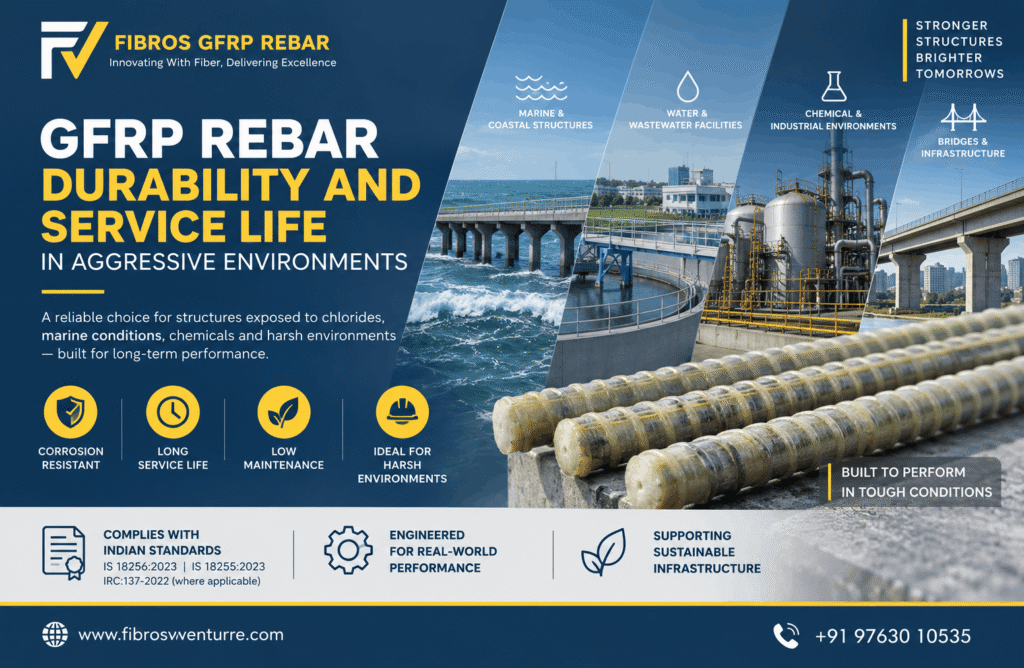
Durability is one of the most important considerations when selecting reinforcement for concrete structures exposed to aggressive environments. In conventional reinforced concrete, corrosion of embedded steel can eventually contribute to cracking, delamination, spalling and loss of reinforcement section when moisture, chlorides or other aggressive agents reach the reinforcement.
Glass Fibre Reinforced Polymer (GFRP) rebar changes this durability problem because it does not undergo the electrochemical rusting mechanism associated with carbon-steel reinforcement.
This characteristic makes GFRP particularly relevant for concrete structures exposed to chlorides, moisture, chemicals, groundwater, repeated wetting and other conditions where reinforcement corrosion is a significant lifecycle concern.
However, describing GFRP simply as “non-corrosive” does not provide a complete engineering assessment. GFRP is a composite material consisting of continuous glass fibres embedded in a polymer matrix. Its long-term performance depends on the fibres, resin system, manufacturing quality, environmental conditions, temperature and sustained stress.
Therefore, GFRP rebar durability and service life should be evaluated through material qualification, structural design, exposure assessment, construction quality and project-specific QA.
The source similarly emphasizes that durability depends on glass, resin, manufacturing quality, surface treatment, sustained stress, temperature and chemical environment—not merely on the absence of steel corrosion.
Why Reinforcement Corrosion Is a Major Durability Problem
Steel performs successfully in millions of reinforced-concrete structures, but aggressive exposure can create long-term durability challenges.
When the conditions necessary for corrosion develop around conventional reinforcement, deterioration can eventually affect both the reinforcement and surrounding concrete.
Potential consequences can include:
corrosion → expansion of corrosion products → concrete cracking → delamination/spalling → repairs → maintenance disruption.
The severity and timing depend on exposure, concrete quality, cover, detailing, construction quality and maintenance.
GFRP removes the conventional carbon-steel rusting mechanism from this chain. This is one of the principal reasons it deserves engineering consideration in corrosion-sensitive structures.
It does not mean that the entire concrete structure becomes maintenance-free. Concrete itself, joints, waterproofing systems, bearings and other components may still require inspection and maintenance.
The benefit is more specific: GFRP can substantially change the reinforcement-corrosion risk within an appropriately designed concrete structure.
Where Aggressive Environments Occur
Aggressive exposure is not limited to marine structures.
GFRP reinforcement may be considered for applications involving:
- marine and coastal concrete;
- bridge decks and barriers;
- road infrastructure exposed to moisture or aggressive agents;
- water and wastewater structures;
- chemical and industrial facilities;
- foundations exposed to groundwater;
- retaining structures;
- tanks and treatment facilities; and
- concrete elements subjected to repeated wetting.
The engineering decision should always begin with the actual exposure.
A structure in a benign indoor environment with easy maintenance access may present a different lifecycle case from a bridge, coastal structure or treatment plant where corrosion-related repair could be difficult and disruptive.
Does GFRP Rebar Corrode?
GFRP does not rust through the electrochemical corrosion mechanism of conventional carbon steel.
That distinction is important.
But “does not rust” should not be converted into a claim that GFRP is completely unaffected by every environmental condition.
Long-term composite durability can depend on:
resin quality + fibre protection + alkaline exposure + moisture + chemicals + temperature + sustained loading + manufacturing quality.
The resin matrix plays an important role in protecting the reinforcing fibres and transferring stresses within the composite.
For this reason, engineers and buyers should evaluate the qualified GFRP product rather than assuming that every FRP bar has identical durability.
The source specifically recommends supporting durability claims through standardized testing, manufacturing control and relevant field evidence rather than relying on one accelerated test or generic claims about all FRP products.
Service Life Is More Than Corrosion Resistance
Service life should be considered at the structural-system level.
A durable reinforcement material cannot compensate for inadequate structural design, poor concrete, incorrect detailing or defective construction.
A GFRP-reinforced member must still satisfy requirements related to:
strength, deflection, cracking, bond, development, anchorage, durability and constructability.
This is especially important because GFRP generally has a lower elastic modulus than conventional reinforcing steel and behaves essentially linearly elastically in tension until rupture.
Therefore, high tensile capacity alone should never be used as evidence of long-term structural performance.
Serviceability can become an important design consideration, particularly for deflection and crack control.
GFRP in Chloride and Marine Environments
Marine and chloride exposure represents an important potential application for non-corrosive reinforcement.
Structures near seawater, coastal zones or chloride-rich environments can create demanding durability conditions for conventional reinforced concrete.
GFRP eliminates electrochemical steel rusting from the reinforcement system, making it particularly interesting where the owner wants to reduce dependence on future corrosion-related repairs.
However, the complete member must still be designed for the actual environmental conditions.
Concrete properties, cracking, structural loads, bond, temperature, chemical exposure and the qualified durability characteristics of the GFRP product remain relevant.
Therefore, GFRP should be selected because its material characteristics address a defined durability problem—not simply because the project is located near water.
GFRP in Chemical and Industrial Environments
Industrial structures can present another important application area.
Concrete elements may be exposed to moisture, process chemicals, wastewater or other aggressive environments.
In such applications, engineers should identify the actual chemical exposure rather than making a broad statement that GFRP is “chemical resistant.”
Compatibility can depend on chemical type, concentration, temperature, exposure duration and the resin system used in the bar.
A technically responsible specification therefore connects the environmental conditions to product-specific qualification evidence.
GFRP vs Steel for Durability
| Factor | GFRP Rebar | Conventional Steel |
|---|---|---|
| Electrochemical rusting | Does not rust like carbon steel | Susceptible under suitable exposure |
| Chloride exposure | Important application potential | Corrosion protection may be required |
| Moisture exposure | No conventional steel rusting | Long-term corrosion risk can exist |
| Composite durability | Requires resin/fibre qualification | Established steel durability framework |
| Elastic modulus | Generally lower | Higher |
| Tensile behaviour | Linear-elastic to rupture | Characteristic yielding |
| Maintenance potential | May reduce corrosion-related interventions | Depends strongly on exposure/protection |
| Lifecycle evaluation | Project-specific | Project-specific |
This comparison shows why GFRP should not simply be described as “better than steel.”
The appropriate reinforcement depends on structural requirements, exposure, design life, economics and project conditions.
Indian Standards for GFRP Durability and Qualification
Indian engineers now have an increasingly structured standards framework for GFRP reinforcement.
IS 18256:2023 provides a specification for solid round GFRP bars for concrete reinforcement.
IS 18255:2023 addresses methods of testing FRP bars for concrete reinforcement.
For applicable road infrastructure, IRC:137-2022 provides guidance relating to GFRP bars.
These references support specification, testing and technical evaluation. However, the existence of an Indian standard does not automatically provide blanket approval for every product or every project.
Project acceptance remains subject to the governing specification, structural design, consultant, Engineer of Record and relevant project authority. The source explicitly warns against implying automatic approval throughout NHAI, MoRTH, CPWD, Railways, Metro or PWD merely because an Indian standard exists.
Construction Quality Directly Affects Durability
Long-term performance begins before concrete is poured.
GFRP reinforcement should be stored on appropriate supports, protected from unnecessary damage and kept properly identified.
During installation, the site team should check:
bar identification + spacing + cover + laps + anchorage + supports + factory-formed bends + cage stability.
Because GFRP is lightweight, reinforcement cages can be easier to transport and position. However, they also require adequate ties, chairs and restraint to prevent movement during concrete placement and vibration.
Damaged bars, unidentified reinforcement or requests for field bending should trigger the project’s approved engineering or nonconformance procedure rather than informal site modification.
Quality Assurance for Long Service Life
A durability strategy requires traceability.
The project QA system should connect:
Design Approval → Qualified Product → Manufacturing Lot → Test Certificate → Delivery → Installation → Pre-Pour Inspection → As-Built Records
Material documentation should identify the product, bar size, relevant test method, laboratory, measured properties and traceability information.
Receiving inspection should verify quantities, dimensions, identification, visible condition and accompanying documentation.
Before concrete placement, reinforcement spacing, cover, laps, bends, supports, openings and cage stability should be checked against the approved drawings.
This documentation provides evidence that the reinforcement installed in the structure corresponds to the material assumed by the designer.
Lifecycle Cost: Look Beyond Initial Price
The economic case for GFRP should not be based only on the initial reinforcement price.
A proper lifecycle comparison may consider:
reinforcement supply + design + freight + handling + installation + testing + corrosion-protection measures + inspection + future repair + access + shutdown/traffic disruption + required service period.
This is particularly important for bridges, industrial facilities and infrastructure where future repairs may require traffic closures, production shutdowns or difficult access.
The source recommends using exposure-specific lifecycle analysis rather than universal GFRP-versus-steel slogans or guaranteed saving percentages.
Common Mistakes to Avoid
A successful durability strategy should avoid treating GFRP as a direct steel substitute, using one generic tensile value for every product, allowing unapproved field bending, ignoring resin and fibre quality, comparing materials only by ₹/kg, losing batch traceability, or assuming that “non-corrosive” means unlimited resistance to every chemical and temperature condition.
Another important mistake is focusing entirely on material durability while ignoring structural serviceability.
GFRP must satisfy both durability and structural performance.
Conclusion
GFRP rebar durability and service life in aggressive environments should be evaluated as an engineering system rather than a material slogan.
Its most important durability advantage is that it does not undergo the electrochemical rusting mechanism associated with carbon-steel reinforcement. This can make GFRP particularly relevant for marine, chloride-exposed, wet, water-treatment, industrial and other corrosion-sensitive concrete structures.
However, long-term performance still depends on resin and fibre quality, manufacturing control, environmental exposure, structural design, serviceability, bond, detailing, installation and quality assurance.
The correct engineering approach is therefore:
Define Exposure → Establish Service-Life Requirements → Select Qualified GFRP → Design the Concrete-GFRP System → Verify Durability → Control Installation → Maintain Traceability
For Indian projects, IS 18256:2023, IS 18255:2023 and IRC:137-2022 where applicable provide an important framework, but final design and acceptance must always follow the governing project requirements and certified properties of the selected GFRP system. The source itself frames the topic this way: GFRP durability must be evaluated with GFRP-specific properties, structural and serviceability checks, approved detailing and project QA.
Engineering Disclaimer: This article provides general engineering information. It does not replace project-specific structural calculations, current standards, contract specifications, product qualification or approval by the Engineer of Record.