
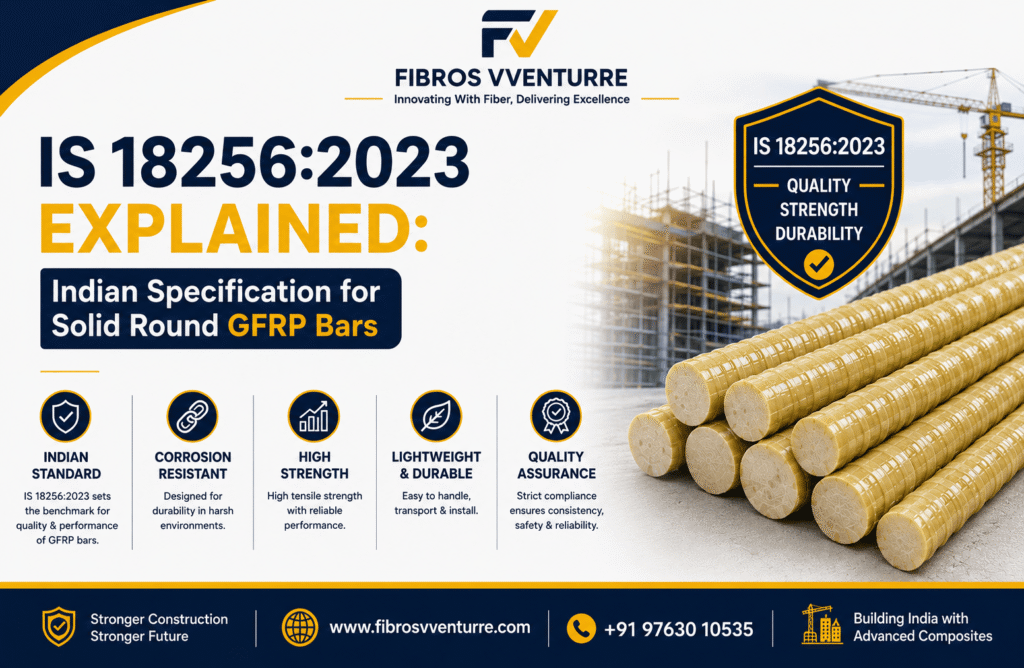
What Is IS 18256:2023?
IS 18256:2023 – Solid Round Glass Fibre Reinforced Polymer (GFRP) Bars for Concrete Reinforcement – Specification is an important Indian standard supporting the specification and controlled use of GFRP reinforcement in concrete construction.
Its significance goes beyond providing another material specification. GFRP bars behave differently from conventional reinforcing steel and therefore need appropriate material qualification, testing, engineering design, detailing, procurement and quality-control procedures.
GFRP reinforcement consists primarily of continuous glass fibres embedded in a polymer matrix. It offers important characteristics for reinforced-concrete construction, particularly its resistance to the electrochemical corrosion mechanism associated with conventional carbon-steel reinforcement.
However, IS 18256 compliance should never be interpreted as permission to replace steel reinforcement bar-for-bar without structural verification.
A GFRP-reinforced member must be engineered using the applicable GFRP design framework and certified properties of the selected reinforcement.
Why IS 18256 Matters for Indian Construction
The introduction of Indian standards for GFRP reinforcement represents an important development for India’s construction industry.
Previously, consultants and contractors evaluating GFRP often depended heavily on international standards, research publications and manufacturer-specific data. An Indian specification provides a common technical framework for manufacturers, designers, laboratories, contractors, procurement teams and approving authorities.
This is particularly relevant as India develops highways, bridges, coastal infrastructure, water-treatment facilities, industrial structures and other assets where reinforcement durability can influence lifecycle performance.
The existence of IS 18256 does not eliminate engineering judgement. Instead, it provides a framework within which the proposed reinforcement can be specified, qualified and verified.
GFRP Is Fundamentally Different from Steel
One of the most important concepts for engineers considering IS 18256 GFRP rebar is that GFRP and steel should not be treated as mechanically identical materials.
GFRP reinforcement can provide high tensile capacity, but its elastic modulus is lower than that of conventional reinforcing steel. Its stress-strain response is also essentially linear elastic up to rupture rather than exhibiting the familiar yielding behaviour of reinforcing steel.
These differences can make the following considerations particularly important:
- deflection;
- crack-width control;
- reinforcement ratio;
- bar spacing;
- bond behaviour;
- development length;
- lap splices;
- anchorage; and
- detailing of bent and transverse reinforcement.
For this reason, comparing GFRP and steel only on their headline tensile-strength values can be misleading.
The engineer must consider the entire reinforced-concrete member and its required structural performance.
Read more: GFRP Rebar vs Steel Rebar
IS 18256 and IS 18255: What Is the Difference?
The two standards have complementary roles.
IS 18256:2023
IS 18256:2023 provides the Indian specification for solid round GFRP bars for concrete reinforcement.
IS 18255:2023
IS 18255:2023 addresses methods of test for fibre-reinforced polymer bars used for concrete reinforcement.
The distinction is important.
A specification defines requirements for the product, while appropriate test methods provide the framework through which relevant properties can be measured and verified.
For a project, therefore, a statement such as “GFRP rebar as per IS 18256” should be supported by appropriate documentation, product identification, traceable testing and the requirements of the project specification.
What Should Engineers Check When Selecting GFRP Rebar?
Compliance should form part of a broader technical evaluation.
1. Product identification and traceability
The proposed reinforcement should be clearly identifiable by manufacturer, product family, diameter, surface configuration and relevant production or batch information.
Mixing design properties from different manufacturers or bar systems can undermine the technical basis of a calculation.
2. Mechanical properties
Engineers should use properties applicable to the exact GFRP product being designed.
The distinction between tested, declared, guaranteed and design values is important. Appropriate reduction factors and project requirements must be considered under the governing design methodology.
3. Surface profile and bond
Bond transfers force between the GFRP reinforcement and surrounding concrete.
GFRP products can use sand-coated, ribbed, helically wrapped or combined surface systems. These should not automatically be considered interchangeable.
Development lengths, lap splices and anchorage should correspond to the approved design method and qualified bar system.
4. Durability
One of GFRP’s principal attractions is that it does not undergo electrochemical rusting like conventional carbon steel.
Nevertheless, composite durability still requires engineering evaluation.
Resin quality, glass fibres, manufacturing quality, alkaline exposure, moisture, chemicals, temperature and sustained loading can influence long-term performance.
Therefore, “non-corrosive” should not be interpreted as “unaffected by every environment.”
Serviceability Can Govern GFRP Design
With conventional reinforcement, engineers are accustomed to steel’s relatively high elastic modulus and ductile yielding behaviour.
GFRP behaves differently.
Because its elastic modulus is lower than steel, deflection and cracking can become important design considerations.
An efficient GFRP design therefore considers member depth, reinforcement ratio, bar spacing, concrete properties, loading and support conditions together.
Simply increasing the reinforcement quantity may not always provide the optimum solution because congestion, bond, concrete placement and cost must also be considered.
The objective should be to design a GFRP-reinforced concrete system, not to reproduce an existing steel reinforcement schedule using a different material.
IS 18256 and Indian Road Infrastructure
For road applications, another important reference is IRC:137-2022, where applicable to the proposed application and project requirements.
This creates an important standards environment for Indian highway engineers considering GFRP.
However, a crucial distinction must be maintained:
The existence of IS 18256:2023 does not mean that every GFRP product or every proposed application is automatically approved by NHAI, MoRTH, PWD, CPWD, Railways, Metro authorities or another government agency.
Project acceptance remains subject to the applicable contract, structural design, consultant requirements, authority requirements, technical submittal and approval process.
Manufacturers and suppliers should therefore avoid unsupported statements suggesting universal government approval.
What Should a GFRP Material Approval Package Contain?
For a major EPC or government project, GFRP approval should be treated as an engineering documentation process rather than a marketing exercise.
A robust technical submittal may include:
- manufacturer information;
- applicable material specification;
- product technical data;
- relevant certification;
- traceable test reports;
- independent laboratory reports where required;
- declared design properties;
- bar diameters and surface system;
- reinforcement drawings and bar schedules;
- method statement;
- inspection and test plan;
- storage and handling procedure; and
- verifiable project references where relevant.
The approving engineer may require additional calculations or project-specific testing.
Construction and Installation Requirements
Compliance does not end when the material leaves the factory.
Installation quality directly affects the performance of a GFRP-reinforced element.
Bars should be properly identified and stored on suitable supports. Unnecessary dragging over rough surfaces should be avoided, and the reinforcement should be protected against damage and contamination.
Before concreting, the site team should check:
- bar diameter and identification;
- spacing;
- cover;
- lap lengths;
- anchorage;
- supports and chairs;
- bent elements;
- reinforcement around openings; and
- cage stability.
Because GFRP is lightweight, reinforcement cages can be easier to handle. However, insufficient restraint may allow a cage to move, spread or rotate during concrete placement.
A GFRP-specific installation method statement is therefore preferable to simply copying a conventional steel-reinforcement procedure.
Can GFRP Rebars Be Bent on Site?
Field bending should not be assumed to be acceptable.
Where structural detailing requires stirrups, U-bars, L-bars, rings or other bent reinforcement, approved factory-manufactured shapes should be coordinated during design and procurement.
The reinforcement drawings and bar bending schedule should clearly distinguish straight bars from factory-formed components.
Unapproved heating, bending or reshaping can affect the composite reinforcement and should not be undertaken as an informal site modification.
Quality Assurance and Procurement
Procurement teams should avoid purchasing GFRP reinforcement based only on the lowest price per kilogram.
GFRP and steel have significantly different densities, so ₹/kg alone is not an adequate measure of equivalent installed reinforcement.
A technically complete enquiry should specify diameter, length, shape, quantity, applicable standard, required test documentation, identification system, packaging, delivery sequence and restrictions on substitutions.
Likewise, QA should preserve traceability from manufacturing or delivery lots through inspection and installation records.
For important projects, the owner should ultimately retain approved calculations, drawings, certificates, inspection records, test reports, as-built information and relevant photographs.
IS 18256 Does Not Mean One-for-One Steel Replacement
Perhaps the most important engineering message is this:
GFRP rebar should not normally be substituted directly for TMT steel solely by matching bar diameter.
Different stiffness, bond behaviour, stress-strain characteristics and design philosophy mean that the reinforced-concrete element should be verified using the appropriate GFRP design methodology.
The Engineer of Record remains responsible for determining the suitability of the reinforcement for the specific structure, loading, exposure and service conditions.
Conclusion
IS 18256:2023 is an important milestone for GFRP rebar in India. It establishes an Indian specification for solid round GFRP bars for concrete reinforcement and provides a stronger foundation for technical specification, product qualification and quality control.
Together with IS 18255:2023 for FRP-bar test methods and IRC:137-2022 for applicable road-project use, it contributes to a more structured engineering environment for GFRP reinforcement in India.
But standardisation does not eliminate the need for design.
GFRP’s corrosion resistance, lightweight nature and high tensile capacity can make it valuable for suitable concrete structures, while its lower elastic stiffness, linear-elastic rupture behaviour, bond characteristics and fabrication requirements demand GFRP-specific engineering.
Primary Keyword: IS 18256
Secondary Keywords: IS 18256:2023, GFRP Rebar India, GFRP Rebar Standard India, Glass Fibre Reinforced Polymer Rebar, FRP Reinforcement, IS 18255:2023, GFRP Rebar Specification, GFRP Rebar Testing, GFRP Construction
What Is IS 18256:2023?
IS 18256:2023 – Solid Round Glass Fibre Reinforced Polymer (GFRP) Bars for Concrete Reinforcement – Specification is an important Indian standard supporting the specification and controlled use of GFRP reinforcement in concrete construction.
Its significance goes beyond providing another material specification. GFRP bars behave differently from conventional reinforcing steel and therefore need appropriate material qualification, testing, engineering design, detailing, procurement and quality-control procedures.
GFRP reinforcement consists primarily of continuous glass fibres embedded in a polymer matrix. It offers important characteristics for reinforced-concrete construction, particularly its resistance to the electrochemical corrosion mechanism associated with conventional carbon-steel reinforcement.
However, IS 18256 compliance should never be interpreted as permission to replace steel reinforcement bar-for-bar without structural verification.
A GFRP-reinforced member must be engineered using the applicable GFRP design framework and certified properties of the selected reinforcement.
Why IS 18256 Matters for Indian Construction
The introduction of Indian standards for GFRP reinforcement represents an important development for India’s construction industry.
Previously, consultants and contractors evaluating GFRP often depended heavily on international standards, research publications and manufacturer-specific data. An Indian specification provides a common technical framework for manufacturers, designers, laboratories, contractors, procurement teams and approving authorities.
This is particularly relevant as India develops highways, bridges, coastal infrastructure, water-treatment facilities, industrial structures and other assets where reinforcement durability can influence lifecycle performance.
The existence of IS 18256 does not eliminate engineering judgement. Instead, it provides a framework within which the proposed reinforcement can be specified, qualified and verified.
GFRP Is Fundamentally Different from Steel
One of the most important concepts for engineers considering IS 18256 GFRP rebar is that GFRP and steel should not be treated as mechanically identical materials.
GFRP reinforcement can provide high tensile capacity, but its elastic modulus is lower than that of conventional reinforcing steel. Its stress-strain response is also essentially linear elastic up to rupture rather than exhibiting the familiar yielding behaviour of reinforcing steel.
These differences can make the following considerations particularly important:
- deflection;
- crack-width control;
- reinforcement ratio;
- bar spacing;
- bond behaviour;
- development length;
- lap splices;
- anchorage; and
- detailing of bent and transverse reinforcement.
For this reason, comparing GFRP and steel only on their headline tensile-strength values can be misleading.
The engineer must consider the entire reinforced-concrete member and its required structural performance.
Read more: GFRP Rebar vs Steel Rebar
IS 18256 and IS 18255: What Is the Difference?
The two standards have complementary roles.
IS 18256:2023
IS 18256:2023 provides the Indian specification for solid round GFRP bars for concrete reinforcement.
IS 18255:2023
IS 18255:2023 addresses methods of test for fibre-reinforced polymer bars used for concrete reinforcement.
The distinction is important.
A specification defines requirements for the product, while appropriate test methods provide the framework through which relevant properties can be measured and verified.
For a project, therefore, a statement such as “GFRP rebar as per IS 18256” should be supported by appropriate documentation, product identification, traceable testing and the requirements of the project specification.
What Should Engineers Check When Selecting GFRP Rebar?
Compliance should form part of a broader technical evaluation.
1. Product identification and traceability
The proposed reinforcement should be clearly identifiable by manufacturer, product family, diameter, surface configuration and relevant production or batch information.
Mixing design properties from different manufacturers or bar systems can undermine the technical basis of a calculation.
2. Mechanical properties
Engineers should use properties applicable to the exact GFRP product being designed.
The distinction between tested, declared, guaranteed and design values is important. Appropriate reduction factors and project requirements must be considered under the governing design methodology.
3. Surface profile and bond
Bond transfers force between the GFRP reinforcement and surrounding concrete.
GFRP products can use sand-coated, ribbed, helically wrapped or combined surface systems. These should not automatically be considered interchangeable.
Development lengths, lap splices and anchorage should correspond to the approved design method and qualified bar system.
4. Durability
One of GFRP’s principal attractions is that it does not undergo electrochemical rusting like conventional carbon steel.
Nevertheless, composite durability still requires engineering evaluation.
Resin quality, glass fibres, manufacturing quality, alkaline exposure, moisture, chemicals, temperature and sustained loading can influence long-term performance.
Therefore, “non-corrosive” should not be interpreted as “unaffected by every environment.”
Serviceability Can Govern GFRP Design
With conventional reinforcement, engineers are accustomed to steel’s relatively high elastic modulus and ductile yielding behaviour.
GFRP behaves differently.
Because its elastic modulus is lower than steel, deflection and cracking can become important design considerations.
An efficient GFRP design therefore considers member depth, reinforcement ratio, bar spacing, concrete properties, loading and support conditions together.
Simply increasing the reinforcement quantity may not always provide the optimum solution because congestion, bond, concrete placement and cost must also be considered.
The objective should be to design a GFRP-reinforced concrete system, not to reproduce an existing steel reinforcement schedule using a different material.
IS 18256 and Indian Road Infrastructure
For road applications, another important reference is IRC:137-2022, where applicable to the proposed application and project requirements.
This creates an important standards environment for Indian highway engineers considering GFRP.
However, a crucial distinction must be maintained:
The existence of IS 18256:2023 does not mean that every GFRP product or every proposed application is automatically approved by NHAI, MoRTH, PWD, CPWD, Railways, Metro authorities or another government agency.
Project acceptance remains subject to the applicable contract, structural design, consultant requirements, authority requirements, technical submittal and approval process.
Manufacturers and suppliers should therefore avoid unsupported statements suggesting universal government approval.
What Should a GFRP Material Approval Package Contain?
For a major EPC or government project, GFRP approval should be treated as an engineering documentation process rather than a marketing exercise.
A robust technical submittal may include:
- manufacturer information;
- applicable material specification;
- product technical data;
- relevant certification;
- traceable test reports;
- independent laboratory reports where required;
- declared design properties;
- bar diameters and surface system;
- reinforcement drawings and bar schedules;
- method statement;
- inspection and test plan;
- storage and handling procedure; and
- verifiable project references where relevant.
The approving engineer may require additional calculations or project-specific testing.
Construction and Installation Requirements
Compliance does not end when the material leaves the factory.
Installation quality directly affects the performance of a GFRP-reinforced element.
Bars should be properly identified and stored on suitable supports. Unnecessary dragging over rough surfaces should be avoided, and the reinforcement should be protected against damage and contamination.
Before concreting, the site team should check:
- bar diameter and identification;
- spacing;
- cover;
- lap lengths;
- anchorage;
- supports and chairs;
- bent elements;
- reinforcement around openings; and
- cage stability.
Because GFRP is lightweight, reinforcement cages can be easier to handle. However, insufficient restraint may allow a cage to move, spread or rotate during concrete placement.
A GFRP-specific installation method statement is therefore preferable to simply copying a conventional steel-reinforcement procedure.
Can GFRP Rebars Be Bent on Site?
Field bending should not be assumed to be acceptable.
Where structural detailing requires stirrups, U-bars, L-bars, rings or other bent reinforcement, approved factory-manufactured shapes should be coordinated during design and procurement.
The reinforcement drawings and bar bending schedule should clearly distinguish straight bars from factory-formed components.
Unapproved heating, bending or reshaping can affect the composite reinforcement and should not be undertaken as an informal site modification.
Quality Assurance and Procurement
Procurement teams should avoid purchasing GFRP reinforcement based only on the lowest price per kilogram.
GFRP and steel have significantly different densities, so ₹/kg alone is not an adequate measure of equivalent installed reinforcement.
A technically complete enquiry should specify diameter, length, shape, quantity, applicable standard, required test documentation, identification system, packaging, delivery sequence and restrictions on substitutions.
Likewise, QA should preserve traceability from manufacturing or delivery lots through inspection and installation records.
For important projects, the owner should ultimately retain approved calculations, drawings, certificates, inspection records, test reports, as-built information and relevant photographs.
IS 18256 Does Not Mean One-for-One Steel Replacement
Perhaps the most important engineering message is this:
GFRP rebar should not normally be substituted directly for TMT steel solely by matching bar diameter.
Different stiffness, bond behaviour, stress-strain characteristics and design philosophy mean that the reinforced-concrete element should be verified using the appropriate GFRP design methodology.
The Engineer of Record remains responsible for determining the suitability of the reinforcement for the specific structure, loading, exposure and service conditions.
Conclusion
IS 18256:2023 is an important milestone for GFRP rebar in India. It establishes an Indian specification for solid round GFRP bars for concrete reinforcement and provides a stronger foundation for technical specification, product qualification and quality control.
Together with IS 18255:2023 for FRP-bar test methods and IRC:137-2022 for applicable road-project use, it contributes to a more structured engineering environment for GFRP reinforcement in India.
But standardisation does not eliminate the need for design.
GFRP’s corrosion resistance, lightweight nature and high tensile capacity can make it valuable for suitable concrete structures, while its lower elastic stiffness, linear-elastic rupture behaviour, bond characteristics and fabrication requirements demand GFRP-specific engineering.