
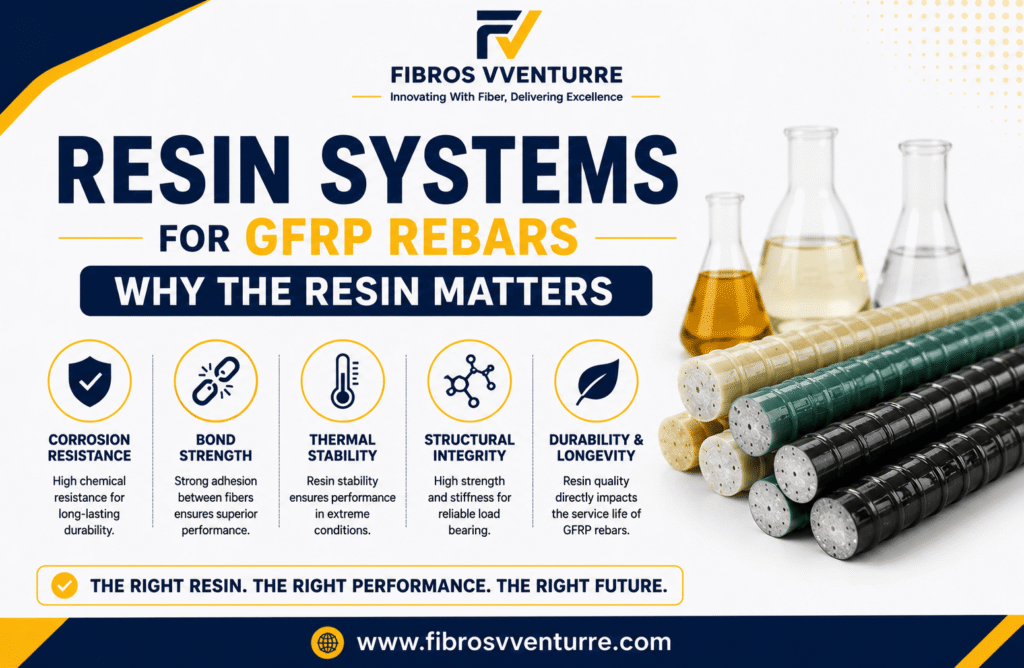
GFRP rebar is not simply a glass-fibre replacement for steel reinforcement. It is a composite material in which continuous glass fibres are embedded within a polymer resin matrix. The fibres provide much of the tensile reinforcement, while the resin matrix binds and protects the fibres and contributes to the overall behaviour of the composite.
This makes the resin system an important part of GFRP rebar engineering.
For infrastructure projects, selecting GFRP should therefore involve more than checking tensile strength or price per kilogram. Engineers and procurement teams should consider the complete material system, including fibre quality, resin system, surface treatment, manufacturing process, certified properties, exposure conditions and quality-control records. The source document specifically identifies glass, resin, manufacturing quality, surface treatment, sustained stress, temperature and chemical environment as factors affecting composite durability.
Two resin families commonly discussed in GFRP applications are epoxy and vinyl ester. Their suitability depends on the intended application, manufacturing process, exposure and qualified product performance.
What Does Resin Do in a GFRP Rebar?
A GFRP rebar contains two fundamental components:
- Continuous glass fibres
- Polymer resin matrix
The glass fibres provide the primary tensile reinforcement. The resin matrix surrounds the fibres and forms the composite structure.
From an engineering perspective, the resin system influences the protection of the fibres, manufacturing consistency and the behaviour of the finished composite under environmental and service conditions.
Instead, the specification should identify the approved product system and its verified performance characteristics.
The source material recommends identifying the exact product, diameter range, resin family, surface configuration, test basis and applicable design/reduction factors so that the design remains traceable from engineering calculation through procurement and installation.
Vinyl Ester vs Epoxy Resin for GFRP Rebars
The choice between vinyl ester and epoxy should be treated as a product-system decision, not simply a choice between two chemical names.
| Engineering consideration | Epoxy resin system | Vinyl ester resin system |
|---|---|---|
| Role in GFRP | Polymer matrix surrounding glass fibres | Polymer matrix surrounding glass fibres |
| Typical engineering focus | Composite quality, fibre bonding and qualified durability | Composite quality, environmental resistance and qualified durability |
| Structural suitability | Must be demonstrated through product testing and design data | Must be demonstrated through product testing and design data |
| Durability evaluation | Exposure-specific qualification required | Exposure-specific qualification required |
| Manufacturing quality | Critical | Critical |
| Surface/bond system | Must be qualified | Must be qualified |
| Procurement approach | Specify certified product properties | Specify certified product properties |
| Best selection method | Match verified performance to project exposure | Match verified performance to project exposure |
The important engineering conclusion is that resin name alone does not establish GFRP rebar quality.
A properly manufactured GFRP bar with a qualified resin system, controlled fibre impregnation, suitable surface profile and verified test performance is fundamentally different from an unverified product that merely claims to contain epoxy or vinyl ester.
Resin Selection and GFRP Durability
One of the principal reasons engineers consider GFRP reinforcement is its resistance to the electrochemical corrosion mechanism associated with conventional carbon-steel reinforcement.
However, “non-corrosive” does not mean “immune to every environmental effect.”
The source material specifically warns that composite durability depends on:
- Resin quality
- Glass fibre quality
- Manufacturing quality
- Surface treatment
- Sustained stress
- Temperature
- Moisture/environment
- Chemical exposure
Therefore, durability must be evaluated as a complete material-system issue rather than based only on the resin label.
For aggressive infrastructure environments, the engineer should ask:
What exposure will the GFRP rebar experience over its design life, and what evidence demonstrates that the selected product can satisfy that exposure?
That is a much stronger engineering question than simply asking whether the product is “corrosion resistant.”
Why Manufacturing Quality Is Critical
Even an appropriate resin system cannot compensate for poor manufacturing.
GFRP rebar production must achieve consistent fibre impregnation, polymerisation/cure and final composite geometry. The finished bar also requires a suitable surface system to develop reliable interaction with concrete.
The source material emphasises that surface profile is important for bond and force transfer. Sand coating, ribs, wraps and other surface configurations should not be treated as automatically interchangeable unless the required performance has been demonstrated through appropriate qualification.
This makes manufacturing QA essential.
A professional GFRP manufacturer should maintain traceability covering:
- Raw-material system
- Production batch
- Bar diameter
- Surface configuration
- Manufacturing date
- Test results
- Finished-product identification
The test certificate should clearly identify the product, bar size, batch/traceability reference, test method, laboratory, measured properties and relevant dates.
Resin System and Structural Design
The resin matrix is only one component of the engineering system. GFRP reinforcement has structural characteristics that differ significantly from conventional steel.
GFRP generally has:
- High tensile strength
- Lower elastic modulus than steel
- Essentially linear-elastic tensile behaviour until rupture
- Different bond behaviour
- Different development and anchorage requirements
Consequently, GFRP cannot normally be substituted for steel on a one-for-one basis.
The source specifically states that GFRP’s stiffness, stress-strain behaviour, bond characteristics and design rules require a qualified engineer to redesign or verify the member using the governing GFRP design framework and certified product properties.
Serviceability is particularly important
Because GFRP has a lower elastic modulus than steel, deflection and crack width can become important design considerations.
An engineer should therefore evaluate:
- Member depth
- Reinforcement ratio
- Bar spacing
- Concrete properties
- Crack control
- Deflection
- Bond
- Development length
- Lap arrangements
- Loading and support conditions
The objective should be to design the concrete–GFRP system, rather than simply copying a steel reinforcement drawing and changing the material description.
Indian Standards Relevant to GFRP Rebars
For Indian projects, the source identifies three particularly relevant references:
IS 18256:2023
This provides an Indian specification for solid round GFRP bars for concrete reinforcement.
IS 18255:2023
This addresses methods of testing FRP bars for concrete reinforcement.
IRC:137-2022
This provides guidance relating to GFRP bars in road projects, within its applicable scope.
These standards create an important technical framework for material specification, testing and project implementation. However, the existence of a standard does not automatically mean that every GFRP product is approved for every government or infrastructure project.
Project-specific requirements, consultant approval, contract conditions and authority requirements still apply.
What Should Engineers Ask the Manufacturer?
Procurement should not be based only on ₹/kg or tensile strength.
A technically complete GFRP procurement specification should identify:
- Required diameter
- Required length
- Straight or bent configuration
- Resin/product system
- Surface profile
- Required design properties
- Applicable standards
- Test certificates
- Batch traceability
- Packaging
- Bar identification
- Delivery requirements
- Factory-formed bends
- Inspection and testing requirements
The source specifically warns against purchasing based only on price or a generic tensile-strength claim. Procurement should connect the supplied product to approved design properties, test evidence, surface system, resin, traceability and drawings.
Construction and Installation Considerations
GFRP is lightweight, which can simplify handling, but lightweight reinforcement can also move during concrete placement if the cage is not adequately restrained.
Therefore, construction teams should pay particular attention to:
- Proper storage
- Bar identification
- Supports and chairs
- Tying
- Cover
- Cage stability
- Approved laps
- Factory-formed bends
- Protection from damage
- Pre-pour inspection
Site procedures should be developed specifically for GFRP rather than simply copying conventional steel procedures.
Field bending should not be assumed to be acceptable. Bent GFRP shapes should normally be produced under controlled manufacturing conditions and supplied according to approved drawings and project requirements.
How Should Owners Evaluate Lifecycle Cost?
The resin system should ultimately be evaluated as part of the complete reinforcement system and the structure’s expected service life.
A lifecycle assessment can consider:
Initial material + design + manufacturing + transportation + installation + testing + maintenance + access + repair + disruption + replacement risk
The economic value of GFRP can be particularly relevant where corrosion-related deterioration would create significant maintenance or operational consequences.
However, responsible engineering content should not promise a universal percentage saving.
The source recommends project-specific whole-life analysis with transparent assumptions and sensitivity testing.
How to Specify a Trustworthy GFRP Resin System
For engineers researching “GFRP rebar India,” “epoxy GFRP rebar,” “vinyl ester GFRP rebar” or “GFRP durability,” trustworthy technical content should demonstrate Experience, Expertise, Authoritativeness and Trustworthiness.
That means:
- Explain actual design and construction considerations.
- Use applicable Indian standards.
- Distinguish certified product data from generic claims.
- Provide traceable testing evidence.
- Avoid unsupported approval claims.
- Clearly state limitations.
- Use real project evidence where available.
- Do not present illustrative scenarios as actual case studies.
This is particularly important for technical manufacturers because engineering credibility is built through evidence, traceability and transparency—not through exaggerated performance claims.
Final Engineering Conclusion
Resin Systems for GFRP Rebars should be selected as part of a complete engineered composite system.
The comparison between vinyl ester and epoxy should not be reduced to “which resin is better?” The correct question is:
Which qualified resin–fibre–surface–manufacturing system provides the required structural and durability performance for the project’s exposure and design requirements?
GFRP can provide an important solution where reinforcement corrosion is a major lifecycle concern, but its successful use depends on much more than corrosion resistance.
Engineers must consider resin quality, fibre quality, surface profile, manufacturing consistency, bond, serviceability, durability, detailing, construction and quality assurance. The source material explicitly identifies these interconnected factors as central to responsible GFRP implementation.
For consultants and owners, the appropriate workflow is to define the structural element, exposure, design life and governing standards first, then evaluate a qualified GFRP product using project-specific calculations and certified properties.
For contractors and procurement teams, the objective is to convert that approved design into an auditable supply, testing and installation package.
For FIBROS VENTURE, the strongest technical positioning is therefore not simply to promote GFRP as a replacement for steel, but to provide verified technical data, traceable testing, controlled manufacturing, buildable reinforcement shapes and transparent engineering limitations while leaving the final structural decision to the Engineer of Record.
That is the foundation of technically credible, durable and specification-ready GFRP reinforcement for India’s next generation of infrastructure.