Modern construction is moving towards materials that provide longer service life, lower maintenance and improved durability. One of the biggest innovations in reinforced concrete is the use of Glass Fiber Reinforced Polymer (GFRP) rebars.
While straight GFRP rebars are becoming increasingly common, many structural elements require reinforcement in different shapes. Foundations need corner reinforcement, beams require stirrups, retaining walls require L-bars and tanks often need U-shaped reinforcement.
This is where Bent GFRP Rebars become essential.
Unlike conventional steel reinforcement, GFRP rebars should not be bent at the construction site. Instead, they are manufactured in the required shape under controlled factory conditions to ensure consistent quality and performance.
Factory-bent GFRP rebars allow engineers to combine the corrosion resistance of GFRP with the geometric flexibility required for modern reinforced concrete construction.
What Are Bent GFRP Rebars?
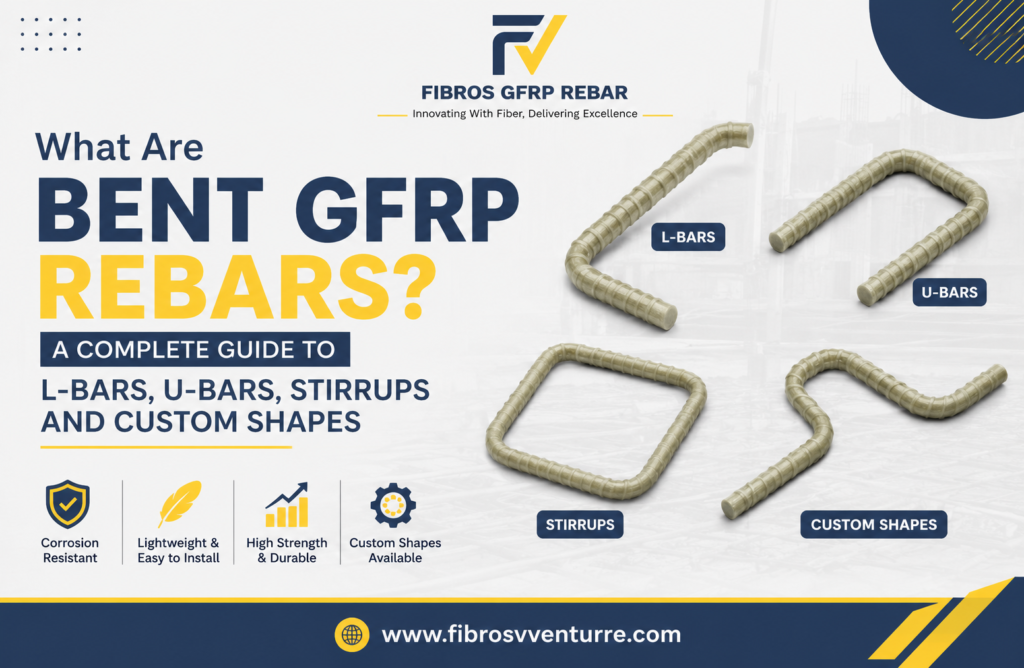
Bent GFRP rebars are reinforcing bars manufactured in predetermined shapes before delivery to the construction site.
Instead of supplying straight bars and bending them later, the manufacturer produces the required geometry according to approved drawings or a Bar Bending Schedule (BBS).
Typical shapes include:
- L-Bars
- U-Bars
- Closed Stirrups
- Open Stirrups
- Corner Bars
- Circular Rings
- Spirals
- Hairpin Bars
- Custom Project Shapes
Every bend is produced under controlled manufacturing conditions so that the dimensions remain accurate and repeatable.
Why Can’t GFRP Bars Be Bent on Site?
- This is one of the most common questions asked by engineers and contractors.
- Steel bars are ductile and can often be bent using approved procedures.
- GFRP behaves differently.
- Its strength comes from continuous glass fibres running along the length of the bar. Heating or forcing a straight GFRP bar into a sharp bend on site can damage those fibres and reduce performance.
- For this reason, required bends should normally be manufactured before delivery rather than created at the construction site.
This approach provides:
- Better dimensional accuracy
- Consistent manufacturing quality
- Reduced installation time
- Lower risk of improper handling
- Better project planning
Types of Bent GFRP Rebars
- L-Bars
L-bars are used wherever reinforcement changes direction.
Common applications include:
- Footing corners
- Wall corners
- Foundation connections
- Lift walls
- Retaining walls
- Bridge parapets
L-bars improve reinforcement continuity around corners while simplifying installation.
U-Bars
U-bars are commonly used where reinforcement wraps around concrete sections.
Applications include:
- Box culverts
- Water tanks
- Drainage channels
- Beams
- Edge beams
- Underground structures
They help maintain reinforcement continuity and simplify fixing work on site.
GFRP Stirrups
Stirrups provide transverse reinforcement in reinforced concrete members.
Typical applications include:
- Beams
- Columns
- Pile caps
- Foundation beams
- Industrial structures
- Marine structures
Because GFRP does not rust like conventional steel, these stirrups are attractive for aggressive environments where corrosion resistance is important.
Circular Rings
Circular reinforcement is commonly required for:
- Circular tanks
- Manholes
- Shafts
- Silos
- Water treatment plants
Factory-made rings provide consistent dimensions and reduce fabrication work at site.
Spiral Reinforcement
Spiral reinforcement is generally used for:
- Circular columns
- Piles
- Water structures
- Bridge foundations
Factory manufacturing improves dimensional consistency throughout the project.
Custom Shapes
Every project is different.
Manufacturers can produce custom reinforcement based on:
- Structural drawings
- CAD drawings
- BBS schedules
- Consultant requirements
- Project specifications
This allows contractors to receive reinforcement ready for installation.
Advantages of Bent GFRP Rebars
a) Faster Installation
- Since bars arrive in their final shape, site labour is reduced.
- Workers spend less time measuring, cutting and arranging reinforcement.
- This can improve productivity on large projects.
b) Improved Accuracy
- Factory production provides consistent dimensions.
- Uniform bends make reinforcement placement easier and help maintain the intended reinforcement layout.
c) Reduced Material Waste
- Site bending often results in cutting losses and damaged bars.
- Factory-produced shapes help optimise material utilisation and reduce unnecessary waste.
d) Better Project Planning
- Receiving reinforcement already prepared allows contractors to organise installation more efficiently.
- It also reduces dependence on site fabrication equipment.
e) Corrosion Resistance
- One of the biggest advantages remains the non-corrosive nature of GFRP.
This makes bent GFRP reinforcement particularly suitable for:
- Marine structures
- Coastal bridges
- Water treatment plants
- Sewage systems
- Chemical plants
- Ports
- Underground structures
Applications of Bent GFRP Rebars
Factory-bent GFRP reinforcement is increasingly considered in projects such as:
Bridges
- Deck slabs
- Edge beams
- Barrier walls
- Expansion joints
Highways
- Box culverts
- Drainage structures
- Retaining walls
- Crash barriers
Marine Projects
- Jetties
- Ports
- Sea walls
- Coastal retaining structures
Buildings
- Foundations
- Lift cores
- Basements
- Staircases
- Parking structures
Water Infrastructure
- Water tanks
- Sewage treatment plants
- Pump houses
- Reservoirs
- Irrigation canals
Industrial Structures
- Chemical plants
- Fertiliser plants
- Pharmaceutical facilities
- Food processing plants
- Warehouses
Ordering Bent GFRP Rebars
To manufacture accurate bent bars, suppliers generally require:
- Structural drawings
- Approved Bar Bending Schedule (BBS)
- Bar diameter
- Shape code
- Leg lengths
- Bend angle
- Quantity
- Delivery schedule
Providing complete information helps reduce delays and manufacturing errors.
Common Mistakes to Avoid
When specifying bent GFRP reinforcement:
- Do not assume it can be bent on site like steel.
- Do not copy steel detailing without engineering review.
- Do not order without a clear BBS or drawing.
- Do not overlook handling and storage instructions.
- Do not mix products from different manufacturers without checking compatibility.
Proper planning at the design stage helps avoid costly changes during construction.
Frequently Asked Questions
- Can GFRP rebars be bent after delivery?
Sharp bends should normally be factory-manufactured. Site bending can damage the fibres and affect performance.
- Are bent GFRP rebars stronger than straight bars?
The straight portions and bend regions have different stress conditions. Performance depends on product qualification, manufacturing quality and project-specific design rather than a simple comparison.
- Can bent GFRP rebars replace bent steel bars?
They can be used where the project has been specifically designed or approved for GFRP reinforcement. They should not be substituted without engineering approval.
- Can custom shapes be manufactured?
Yes. Manufacturers can produce custom shapes based on approved drawings and bar bending schedules, subject to manufacturing capabilities.
- Which industries benefit most from bent GFRP rebars?
Projects exposed to moisture, chlorides or corrosive environments—such as bridges, marine works, water infrastructure and chemical plants—often consider GFRP reinforcement because of its durability characteristics.
Conclusion
Bent GFRP rebars represent the next stage in corrosion-resistant concrete construction. By supplying reinforcement in ready-to-install shapes, they help simplify construction, improve dimensional consistency and reduce on-site fabrication.
Whether a project requires L-bars for retaining walls, U-bars for culverts, stirrups for beams or custom reinforcement for specialised structures, factory-manufactured bent GFRP rebars provide a practical solution when supported by proper engineering design and quality manufacturing.
As infrastructure projects demand longer service life and lower maintenance, the use of bent GFRP reinforcement is expected to continue growing across highways, bridges, marine works, industrial facilities and water infrastructure.
About FIBROS VENTURE
FIBROS VENTURE is a manufacturer and supplier of straight and factory-bent GFRP rebars for infrastructure, industrial and commercial construction projects across India.
Our product range includes:
- Straight GFRP Rebars
- L-Bars
- U-Bars
- GFRP Stirrups
- Circular Rings
- Custom Bent GFRP Shapes
We support contractors, consultants and project owners with technical assistance, project-specific manufacturing and reliable nationwide supply.
If you have a Bar Bending Schedule (BBS) or project drawing, our technical team can help review your requirements and provide a quotation for straight and factory-bent GFRP reinforcement.