Concrete looks solid and permanent, but it has an important weakness: it does not perform as well in tension as it does in compression. That is why concrete structures are reinforced with bars placed inside the concrete.
For generations, those bars have usually been made from steel. Today, another option is becoming increasingly familiar to engineers and contractors: FIBROS GFRP rebar.
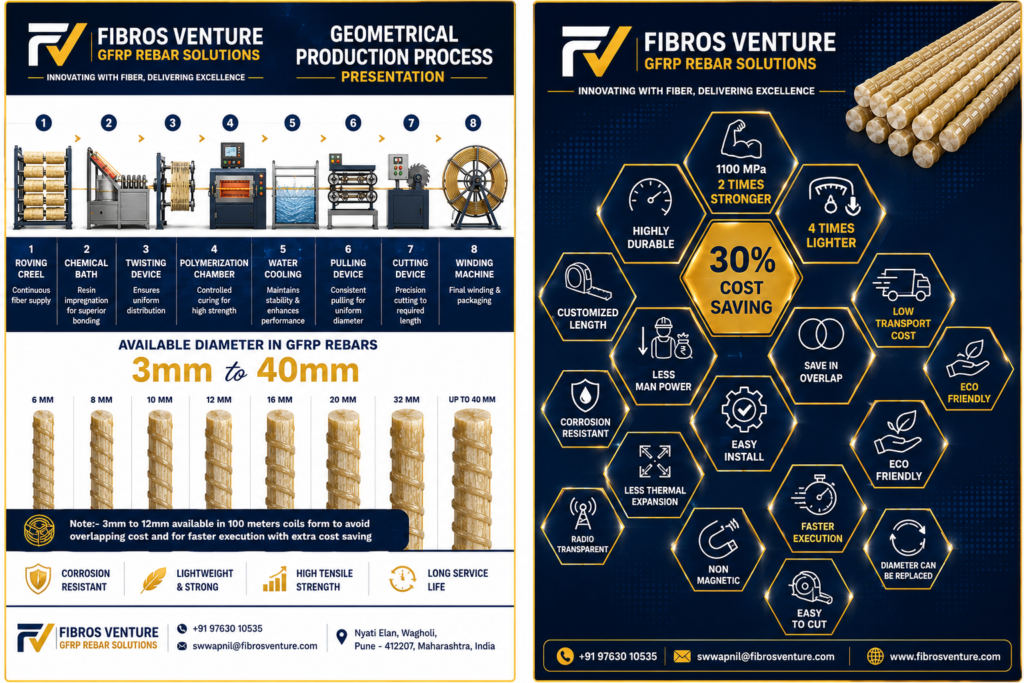
FIBROS GFRP rebar is made from continuous glass fibers held together by a polymer resin. It performs the basic job of reinforcing concrete, but it is not simply a lighter version of steel. It has its own mechanical properties, design rules, handling requirements and suitable applications.
That distinction matters. A successful GFRP project begins with understanding the material for what it is—not treating it as a direct substitute for steel.
What Does GFRP Mean?
GFRP stands for Glass Fiber Reinforced Polymer.
The easiest way to understand the material is to look at its three main parts.
Glass fibers carry the load
Thousands of continuous glass fibers run along the length of a GFRP bar. These fibers provide most of the bar’s tensile capacity.
Because the fibers are mainly aligned lengthwise, GFRP is strongest in that direction. Its properties across the bar, around bends and under shear are different from its longitudinal tensile properties. This is one reason designers must use GFRP-specific engineering rules.
Polymer resin holds the bar together
The glass fibers are embedded in a polymer resin. The resin keeps the fibers in position, transfers forces between them and gives the bar its finished shape.
The choice of resin, the quality of curing and the manufacturing process can all influence the finished product. Buyers should therefore compare tested product data rather than assuming that all GFRP bars are identical.
The outside surface creates a bond with concrete
A GFRP bar normally has a textured surface. It may be ribbed, helically wrapped, sand-coated or manufactured with a combination of surface treatments.
This surface helps transfer force between the concrete and the reinforcing bar. Bond performance is important because the concrete and reinforcement must act together rather than move independently.
The active ASTM D7957/D7957M-25 specification covers solid, round GFRP bars supplied as cut lengths and bent shapes with an enhanced external surface. It addresses qualification, production quality control, geometry, tensile properties, transverse shear, bond and minimum bend dimensions.
Why Is FIBROS GFRP Rebar Used?
The main reason for choosing GFRP is usually durability.
Steel reinforcement can corrode when the protective conditions inside the concrete are disrupted and moisture, oxygen or chlorides reach the steel. The corrosion products occupy more space than the original steel and can place pressure on the surrounding concrete, contributing to cracking and damage.
GFRP is nonmetallic, so it does not rust through the same process as carbon steel. This makes it attractive for structures exposed to seawater, salt spray, de-icing salts, wastewater, groundwater and other environments where steel corrosion is a serious concern.
The American Concrete Institute identifies GFRP reinforcement as non-corrosive, nonmagnetic and lightweight. ACI also recognizes its use in structures where non-ferrous reinforcement is required because of electromagnetic considerations.
This does not mean GFRP is unaffected by every environment. Resin quality, temperature, alkalinity, moisture, sustained stress and exposure duration still matter. Good design and a qualified product remain essential.
How Does GFRP Rebar Work in Concrete?
The principle is similar to other reinforced concrete systems.
When a concrete member bends under load, part of the member is compressed while another part is placed in tension. The reinforcement positioned in the tensile zone helps carry that tensile force.
With GFRP reinforcement, the load follows a connected path:
- The concrete transfers stress to the textured surface of the bar.
- The surface and resin transfer the stress into the body of the bar.
- The glass fibers carry the tensile load along the bar.
The effectiveness of this process depends on more than the tensile strength printed on a data sheet. Bar surface, concrete quality, cover, spacing, embedment length, lap length, environmental conditions and workmanship all affect the completed system.
This is why a bar with a high tensile-strength value is not automatically suitable for every project.
The Main Benefits of FIBROS GFRP Rebar
Corrosion resistance
For many projects, this is the deciding advantage.
GFRP does not experience the rusting mechanism associated with carbon-steel reinforcement. That makes it particularly relevant in structures where chloride exposure or constant moisture could reduce the service life of conventional reinforced concrete.
Possible applications include seawalls, bridge decks, coastal foundations, drainage structures, water-treatment facilities and selected industrial projects.
Corrosion resistance does not make the entire structure maintenance-free. Concrete quality, joints, drainage, cracking, loading and workmanship still need attention. The benefit is specifically the removal of conventional steel-reinforcement corrosion from the durability equation.
Lower weight
GFRP bars are lightweight compared with steel reinforcement.
On a construction site, that can make bundles easier to unload, move and position. It may reduce lifting requirements and make work more manageable in restricted areas.
The actual benefit depends on the project, bundle size and bar dimensions. Buyers should obtain bundle weights from the manufacturer instead of using steel-rebar weight tables.
Nonmagnetic properties
Because GFRP is nonmetallic, it can be considered for areas where large quantities of steel might interfere with sensitive equipment or electromagnetic requirements.
Examples may include selected medical, laboratory, transportation, electrical and communication facilities.
A project involving magnetic or electrical performance should use verified product-specific information. The word “nonmetallic” alone is not a complete technical specification.
High strength in relation to weight
GFRP can provide high tensile capacity along the direction of its glass fibers while remaining relatively light.
However, tensile strength is only one part of structural performance. The engineer must also consider stiffness, ultimate strain, bond, sustained stress, environmental factors, bar size and serviceability.
Choosing reinforcement based only on the highest tensile-strength figure is a common purchasing mistake.
Easier handling and cutting
The lower weight of GFRP can simplify handling. Bars can also be cut using tools and procedures recommended by the manufacturer.
Workers should use suitable personal protective equipment because cutting a composite bar can produce dust and exposed glass fibers. The manufacturer’s cutting, handling and cut-end instructions should be included in the site method statement.
GFRP Rebar Is Not a Direct Replacement for Steel
This is the most important point in the article.
A contractor should never take a drawing designed for steel reinforcement and replace every steel bar with a GFRP bar of the same diameter without an approved redesign.
Steel and GFRP differ in several fundamental ways.
GFRP does not yield like steel
Conventional reinforcing steel can yield and undergo significant deformation before rupture. GFRP behaves differently and does not provide the same yielding stage.
That difference changes how engineers consider failure modes, structural safety and deformability.
GFRP is generally less stiff than steel
A GFRP bar may have high tensile capacity while still having a lower modulus of elasticity than steel.
In practical terms, crack width and deflection may become important design considerations. A member can appear adequate when only ultimate strength is considered but still require changes to satisfy service-level performance.
The designer may need to adjust reinforcement quantity, bar spacing, member thickness or structural geometry.
Bond and development requirements are different
The force in a reinforcing bar must be safely transferred into the surrounding concrete. The required embedment or development length depends on the material, surface configuration, bar diameter, concrete properties, cover and spacing.
Steel development details should not automatically be applied to GFRP.
| Property | FIBROS GFRP rebar | Conventional steel rebar |
|---|---|---|
| Primary material | Glass fibers in a polymer matrix | Carbon steel |
| Rust-related corrosion | Does not rust like carbon steel | Can corrode in the presence of moisture, oxygen and chlorides |
| Weight | Lightweight | Heavier |
| Magnetic behavior | Nonmagnetic | Magnetic |
| Tensile behavior | Generally linear elastic until failure | Can yield before rupture |
| Stiffness | Generally lower than steel | Higher modulus of elasticity |
| Strength direction | Highest along the reinforcing fibers | More uniform metallic behavior |
| Field bending | Generally prohibited | Possible under approved procedures |
| Sharp bent shapes | Normally factory-produced | Commonly shop- or field-fabricated under approved procedures |
| Fire and elevated temperature | Requires GFRP-specific evaluation | Governed by steel-reinforced concrete provisions |
| Design substitution | Requires GFRP-specific engineering | Governed by applicable steel-reinforced concrete design provisions |
Fire and elevated temperatures need separate evaluation
The polymer component of a GFRP bar responds differently to high temperature than steel. Fire rating, concrete cover, resin properties and service temperature therefore require project-specific attention.
ACI CODE-440.11-22 contains dedicated provisions for strength, serviceability, durability, fire resistance, reinforcement development, splicing, detailing and inspection of qualifying GFRP-reinforced concrete.
FIBROS Straight GFRP Rebars and FIBROS Bent GFRP Rebars
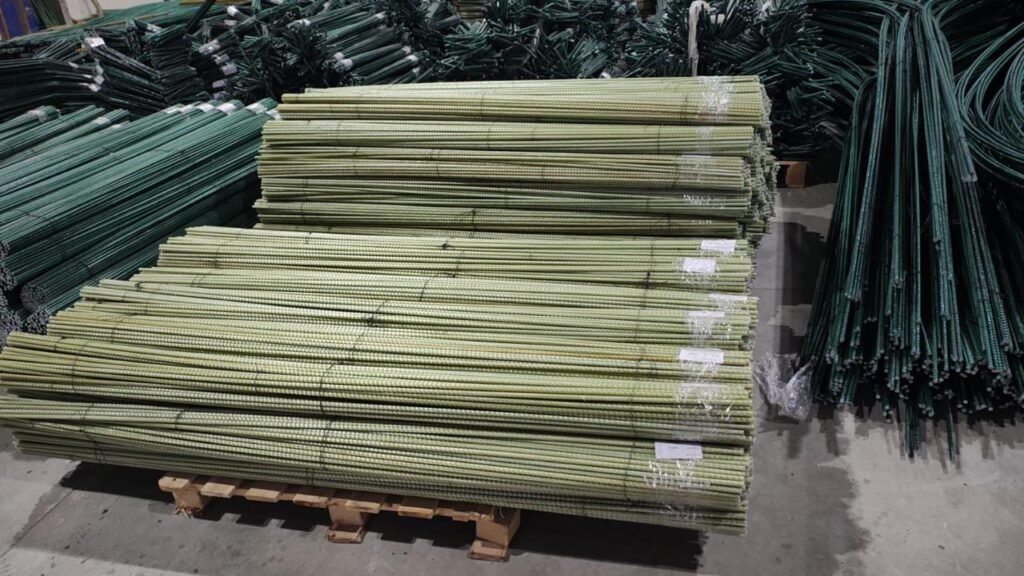
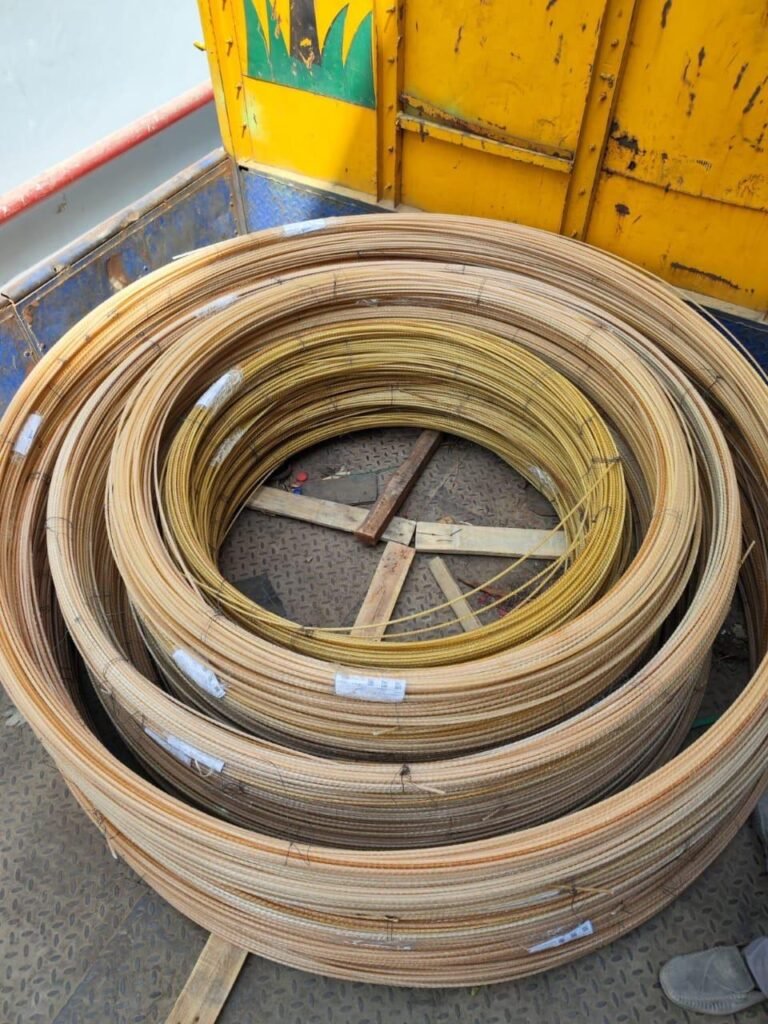
GFRP reinforcement can be supplied in straight lengths and in factory-manufactured bent shapes.
FIBROS Straight bars
Straight GFRP bars may be used as main reinforcement or distribution reinforcement in properly designed concrete elements.
Depending on the project and applicable code, these may include:
- Slabs
- Foundations
- Footings
- Walls
- Beams
- Barriers
- Precast elements
- Marine structures
- Water-retaining structures
The correct bar diameter, spacing, cover, lap and development length must come from the approved structural design.
FIBROS Bent bars
Bent GFRP reinforcement may be supplied in shapes such as:
- L-bars
- U-bars
- Stirrups
- Links
- Corner bars
- Rings
- Spirals
- Project-specific shapes
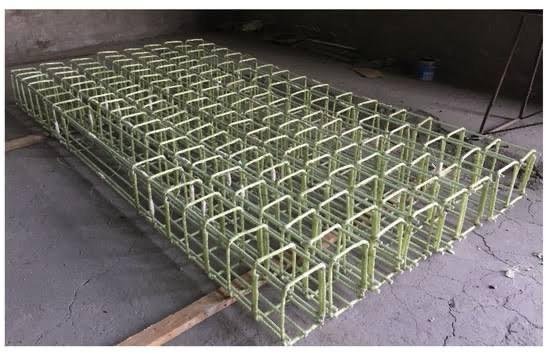
Bent GFRP bars should be planned early. Unlike ordinary steel reinforcement, a straight GFRP bar should not simply be heated and forced into a sharp bend at the construction site.
The bend is a critical part of the product. Its inside radius, leg length, angle and performance need to be established during controlled manufacturing.
ASTM D7957/D7957M-25 specifically includes bent GFRP shapes and minimum inside-bend requirements within its scope.
When ordering bent bars, the supplier should receive an approved bar bending schedule or clearly dimensioned drawing. Dimensions should identify the bar diameter, bend angle, inside radius, leg lengths, quantity and permitted tolerance.
Where Can GFRP Rebar Be Used?
There is no single list that makes GFRP automatically suitable for every structure. Its use depends on design requirements, loading, environmental exposure, fire conditions, local approval and product qualification.
Even so, several application groups are common.
Marine and coastal structures
GFRP is often considered for:
- Seawalls
- Ports
- Jetties
- Coastal foundations
- Marine barriers
- Precast coastal components
- Structures exposed to seawater or salt spray
A documented seawall project published through ACI, for example, selected GFRP reinforcement for corrosion resistance and to avoid staining from corrosion products on exposed surfaces.
Transportation infrastructure
Potential applications include:
- Bridge decks
- Approach slabs
- Parapets
- Concrete barriers
- Road slabs
- Selected tunnel or rail components
Water and wastewater construction
GFRP may be evaluated for:
- Water tanks
- Wastewater-treatment facilities
- Drainage channels
- Culverts
- Pumping stations
- Water-retaining walls
Buildings and general civil construction
Depending on the approved design, GFRP can also be considered for:
- Foundations
- Raft slabs
- Retaining walls
- Industrial floors
- Precast products
- Selected beams, walls and columns
ACI CODE-440.11-22 addresses cast-in-place, precast, nonprestressed and composite construction, with provisions for members including beams, slabs, walls, columns, connections and foundations.
What Should a Buyer Check Before Ordering?
Buying GFRP rebar should involve more than comparing price per metre.
A serious technical offer should identify exactly what product is being supplied and how its properties have been established.
Ask the supplier for:
- The product technical data sheet
- Applicable manufacturing standard
- Available diameters and cross-sectional areas
- Straight-bar lengths and tolerances
- Surface-profile description
- Resin-system information
- Guaranteed tensile properties
- Tensile modulus and ultimate strain
- Bond and transverse-shear information
- Durability or alkali-resistance test data
- Glass-transition-temperature information
- Handling and cutting instructions
- Available bent shapes and bend limitations.
ASTM D7957/D7957M-25 treats qualification, quality control, certification, geometry, physical properties and mechanical properties as central parts of a conforming GFRP product. The standard was listed as active and last updated on January 7, 2026.
Do not use generic values taken from another manufacturer’s brochure. Properties can vary with the fibers, resin, bar size, surface profile and production process.
Which Standards Should Be Referenced?
Standards depend on the country, approving authority and project contract.
For projects using United States-based requirements, three documents are especially relevant.
ASTM D7957/D7957M-25
This is the active ASTM specification for solid, round GFRP bars with external surface enhancement. It covers straight lengths and bent shapes, along with qualification, quality control and property requirements.
ACI CODE-440.11-22
This code provides requirements for the materials, design and detailing of structural concrete reinforced with qualifying GFRP bars.
Its subjects include structural analysis, strength, serviceability, durability, fire resistance, deflection, development, splicing, reinforcement details and inspection. It remained the published ACI Committee 440C code document as of July 2026.
ACI SPEC-440.5-22
This specification addresses construction with GFRP reinforcing bars, including submittals, delivery, storage, handling, accessories, off-site fabrication, installation and repair.
Other countries and project owners may require different standards. The structural engineer and approving authority must identify the governing documents before procurement begins.
Frequently Asked Questions
Is GFRP rebar stronger than steel?
That question cannot be answered accurately using one number.
A GFRP bar may have high tensile capacity, but structural performance also depends on stiffness, ultimate strain, bond, bar diameter, sustained stress, environmental conditions and serviceability.
The correct comparison is not simply “strength versus strength.” It is the complete engineered performance of the reinforced concrete system.
Does GFRP rebar rust?
GFRP does not rust through the same process as carbon-steel reinforcement. This is one of the main reasons it is considered for coastal, marine, wet and chloride-exposed structures.
That does not mean every GFRP product is suitable for every chemical or temperature environment. Product qualification remains necessary.
Can the same steel reinforcement drawing be used?
No. A steel-reinforced design requires engineering review before it is converted to GFRP.
Bar quantity, size, spacing, development, laps, crack control, deflection and other details may need to change.
Can GFRP rebar be used in foundations?
It can be considered for qualifying foundation applications where the design standard, structural calculations and project approvals permit its use. ACI CODE-440.11-22 includes foundation provisions within its scope.
Can straight GFRP rebar be bent at the project site?
Do not attempt to create sharp site bends unless the product manufacturer and project engineer have expressly approved a procedure.
Required L-bars, U-bars, stirrups and other shapes should normally be manufactured in advance with controlled bend geometry.
Are all GFRP rebars the same?
No. Products can differ in glass content, resin, surface configuration, diameter, production method, mechanical properties, durability data and quality control.
A product name or colour is not proof of performance. Approval should be based on verified technical documentation.
Fibros Venture Final Thoughts
GFRP rebar offers a practical answer to one of reinforced concrete’s long-standing challenges: corrosion of conventional steel reinforcement.
Its low weight, nonmetallic composition and corrosion resistance can make it valuable in marine, coastal, transportation, water, wastewater and other demanding applications.
But GFRP must be used correctly.
It is not steel with a different colour. It has its own stiffness, bond behaviour, failure characteristics, bend limitations, temperature considerations and design requirements.
A sound GFRP project combines five things:
- A properly qualified product
- Verified technical data
- GFRP-specific structural design
- Clear fabrication and installation details
- Careful site handling and inspection
When those elements are in place, GFRP can provide a durable and efficient reinforcement solution for modern concrete construction.
Request a GFRP Rebar Quotation
Planning a project with straight or factory-bent GFRP reinforcement?
Send our technical sales team your:
- Bill of quantities
- Bar diameters
- Required lengths
- Bar bending schedule
- Project specification
- Delivery location
- Required test reports and certificates
We can review your requirements for straight GFRP bars, L-bars, U-bars, stirrups and other available factory-manufactured shapes.
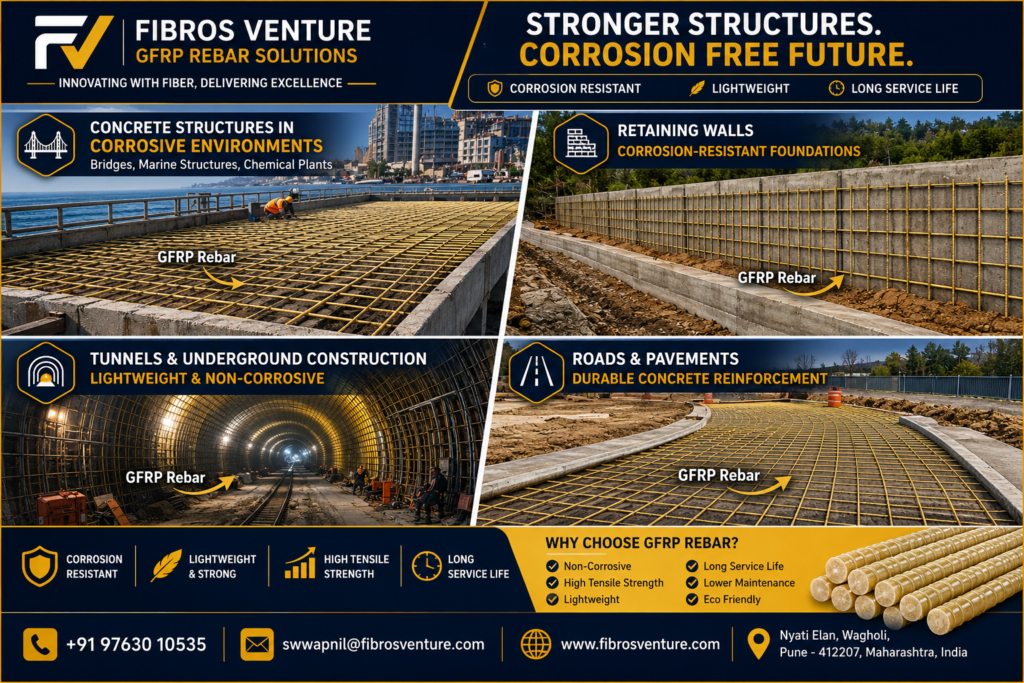
Contact our team for product details, technical documentation and a project quotation.
FIBROS VENTURE
SWWAPNIL HEAMNE
9763010535
swwapnil@fibrosvventurre.com
Engineering notice: This article provides general educational information. It is not a structural design, construction drawing or project specification. Reinforcement size, quantity, spacing, cover, development length, lap length, bend geometry and installation details must be approved by the project’s qualified structural engineer.